No products in the cart.


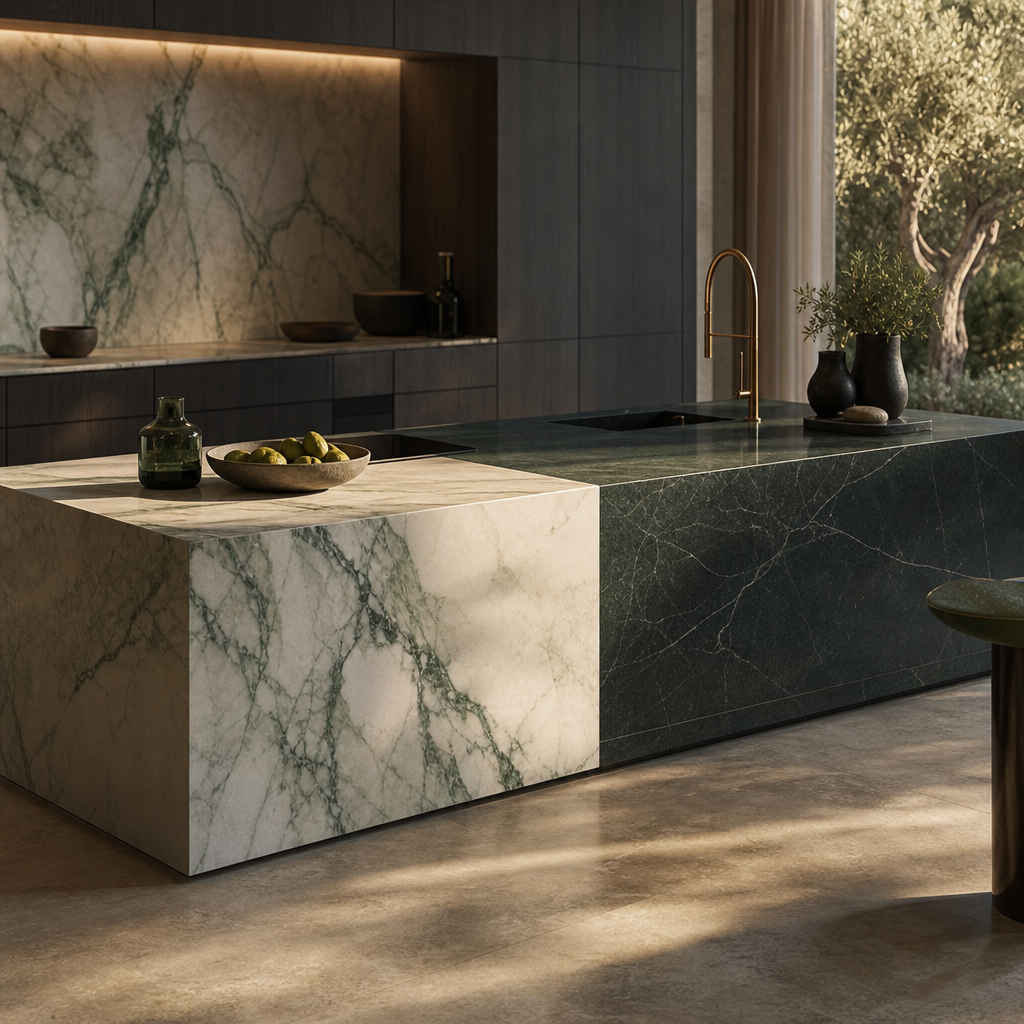
Choosing between marble and porcelain for a countertop is really a choice between two kinds of luxury: living natural stone that changes with use, and an engineered surface built to stay the same. That is the crux of marble vs porcelain slabs for countertops, and the right answer shifts with the room, the cooking, and how much daily care a household or project team is willing to accept. In an Iraqi kitchen with strong sun, hot pans, oil, spices, tea and coffee, those differences stop being abstract very quickly. Below we set out what each material actually is, compare them criterion by criterion, and map the scenarios where marble, porcelain, or a third material fits best.
Table of contents
Two materials, two definitions of luxury
Marble slabs are quarried natural stone, cut and polished into thick pieces, with veining and colour variation unique to every slab. Porcelain slabs are engineered ceramic: refined clays and minerals are pressed and fired at very high temperatures into thin, dense sheets that can imitate marble, concrete, or minimalist solid colours.
Both sit at the top of the perceived-luxury scale, so the decision rarely comes down to prestige alone. Where they part ways is behaviour in daily use — scratch resistance, heat tolerance, staining, and maintenance. Marble is prized for the way it looks and ages; porcelain is engineered for consistency and to resist the things that mark natural stone. Understanding those two intentions is more useful than asking which is objectively better.
Marble slabs: natural stone with character and care
Marble’s appeal is emotional and visual. Deep veining gives each slab a one-of-a-kind character that is genuinely hard to replicate, the surface feels cool to the touch in a warm climate, and in high-end villas and hospitality settings it carries strong associations with classical European luxury.
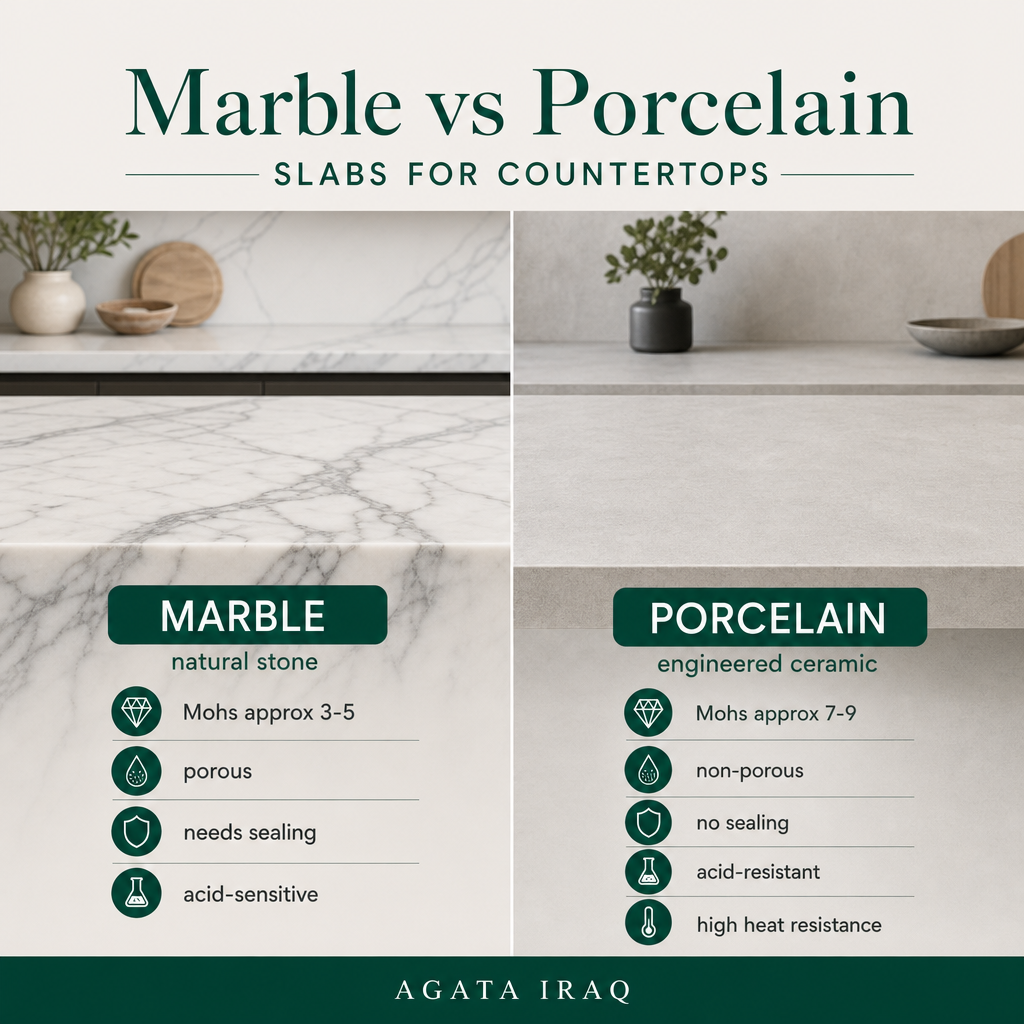
Its performance profile is softer, in every sense. Marble is relatively soft for a stone, typically around 3 to 5 on the Mohs hardness scale, so it scratches and shows wear more readily than harder surfaces. It is porous, meaning it can absorb liquids and stain if not sealed regularly. And it is sensitive to acids — lemon juice, vinegar, pomegranate, some cleaners — which can dull the polish and leave light matte spots known as etching.
In practice a marble top develops a patina: fine scratches, subtle dull areas, and soft colour shifts. Many design-minded owners read this as marble’s charm rather than as damage. The risks worth naming clearly for Iraqi kitchens are staining from coloured oils, sauces, coffee and tea if spills sit too long near cooktops and sinks; etching from everyday food acids even when no deep stain forms; and scratch or chip vulnerability from knives, sliding metal utensils, and impacts on sharp edges. Marble rewards households comfortable with regular sealing, gentle pH-balanced cleaning, and the idea that the surface will visibly live.
Porcelain slabs: an engineered, low-maintenance surface
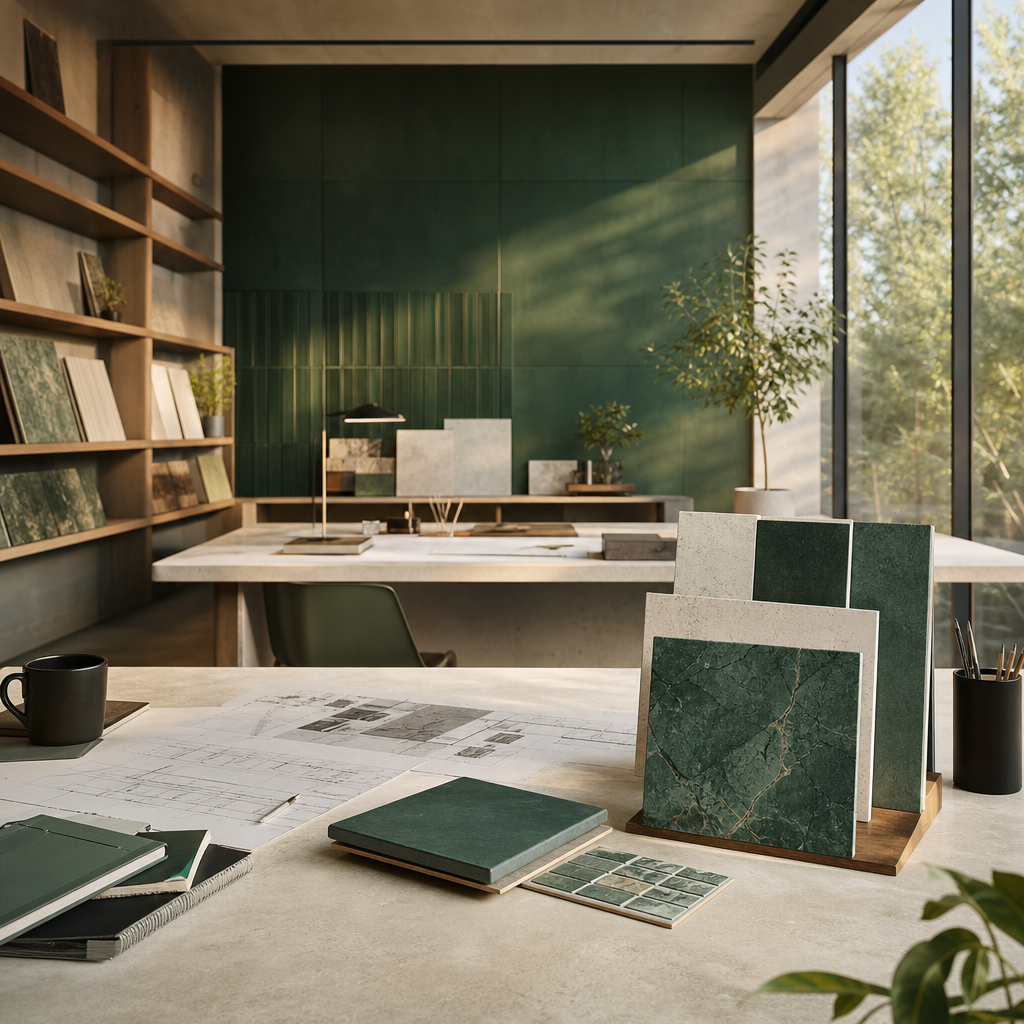
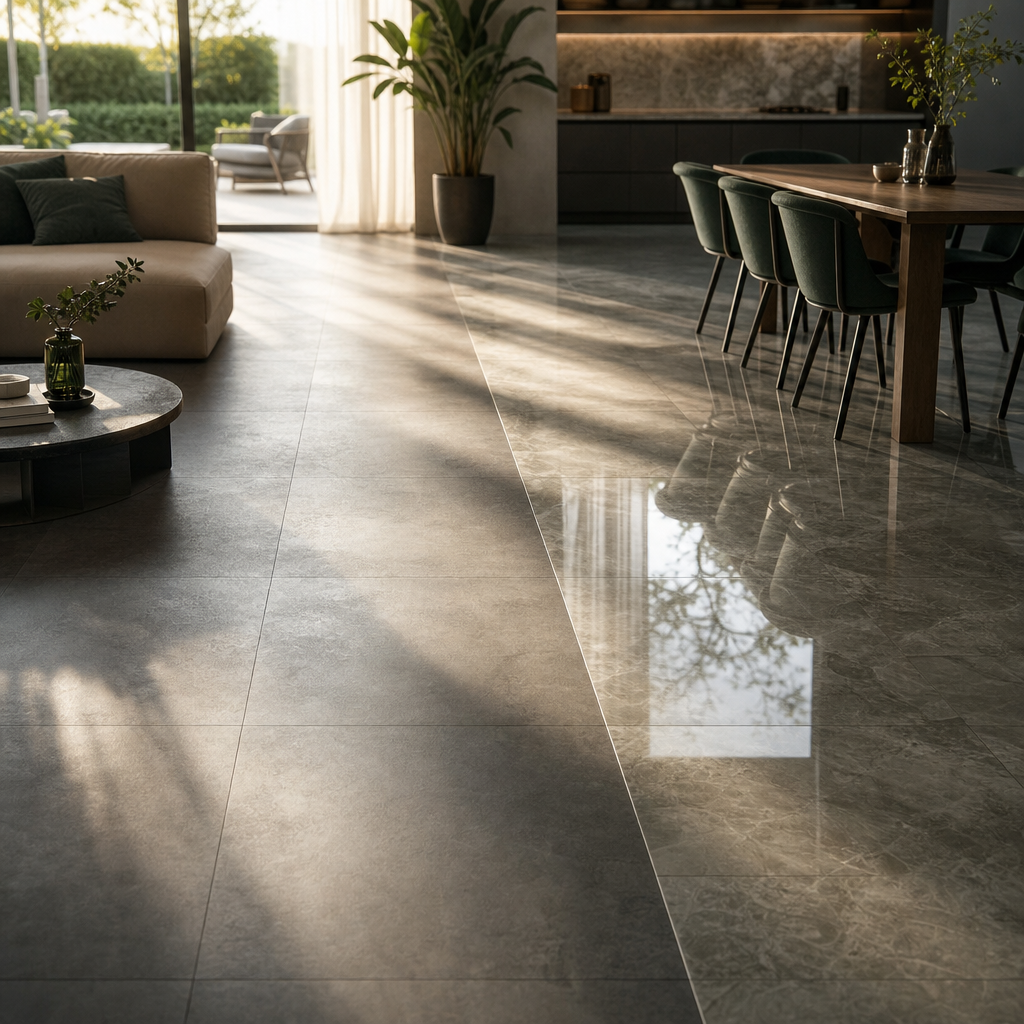
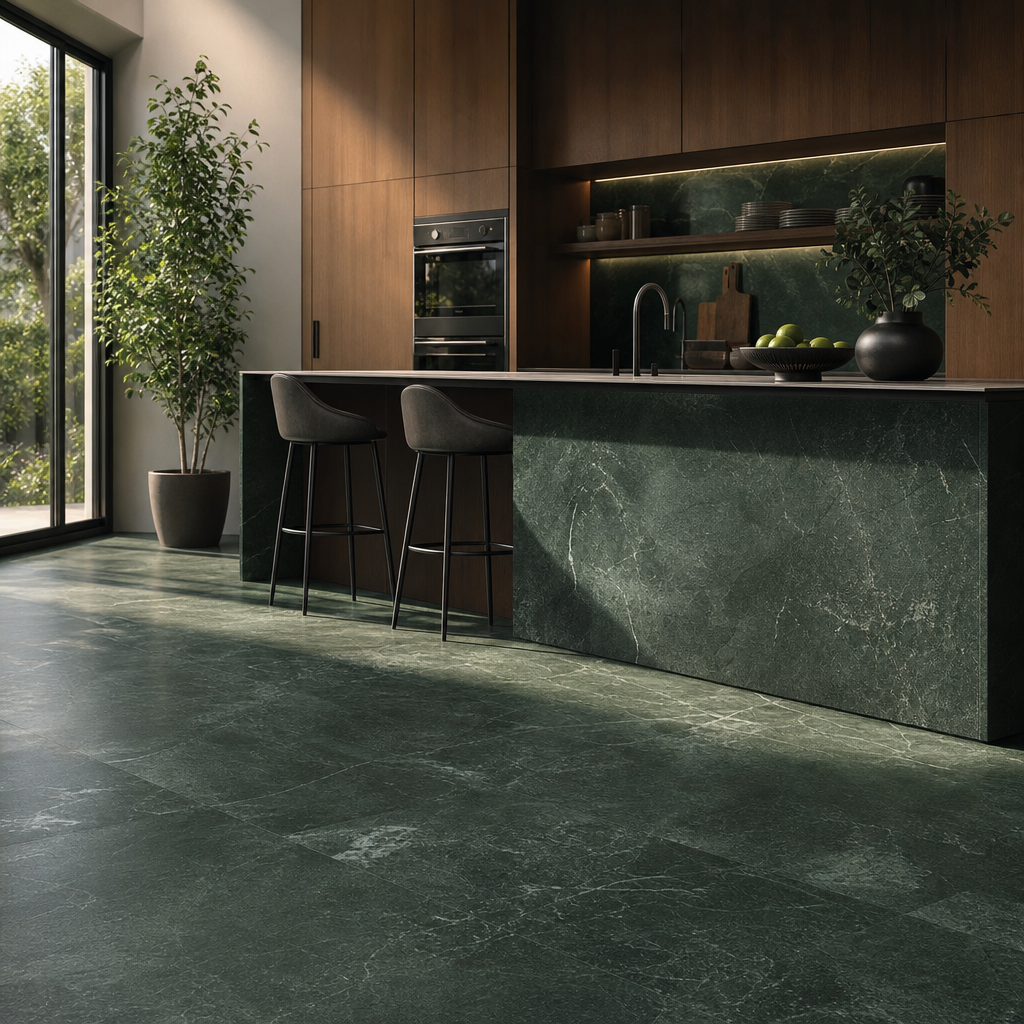
Porcelain slabs are built to give a controlled, predictable result. They can be produced with marble looks, concrete looks, or minimalist solid colours, often with continuous patterns carried across large formats. Because they are thinner and lighter than stone, a single run can cover a large island or wall with fewer joints, and pattern and colour repeat across multiple slabs — which makes a cohesive Scandinavian or minimalist scheme much easier to achieve. If you want the deeper background, our companion explainer on what a porcelain slab actually is covers the material in plain terms.
The performance gap is where porcelain separates itself. It is very hard, often around 7 to 9 on the Mohs scale, giving strong scratch resistance in daily use. It is non-porous and stain-resistant, so oils, coffee and coloured sauces are far less likely to penetrate or leave permanent marks. It is highly resistant to acids and household chemicals because the fired ceramic body is chemically stable. And full-body porcelain slabs are among the most heat-tolerant countertop surfaces, handling higher temperatures than resin-based materials. For hot climates, that adds up to a near “set and forget” surface: no sealing, simple cleaning, and a stable appearance over time.
Porcelain is not risk-free. Thin edges can chip if struck by heavy pots or on mitered corners; large, thin slabs demand specialist fabrication and proper support to avoid cracking during installation; and the finish stays uniform rather than developing the evolving patina that some clients specifically want from natural stone.
Marble vs porcelain, criterion by criterion
The table below matches the two materials on the criteria that decide most countertop projects, so the trade-offs sit side by side rather than scattered through paragraphs.
| Criterion | Marble slabs | Porcelain slabs |
|---|---|---|
| Origin | Natural metamorphic stone, each slab unique | Engineered ceramic made under controlled conditions |
| Aesthetic character | Organic veining and variation, classic luxury feel | Marble, concrete or solid looks with more consistency |
| Scratch resistance | Softer, around Mohs 3-5; shows wear in busy kitchens | Very hard, around Mohs 7-9; resists daily scratches |
| Porosity and stains | Porous; needs sealing to resist oils and sauces | Non-porous; resists staining, no sealing required |
| Acid and heat | Acids can etch; intense heat can mark the finish | Acid-stable; among the most heat-resistant surfaces |
| Maintenance | Regular sealing, gentle cleaners, accepts patina | Low maintenance, neutral detergents, no sealing |
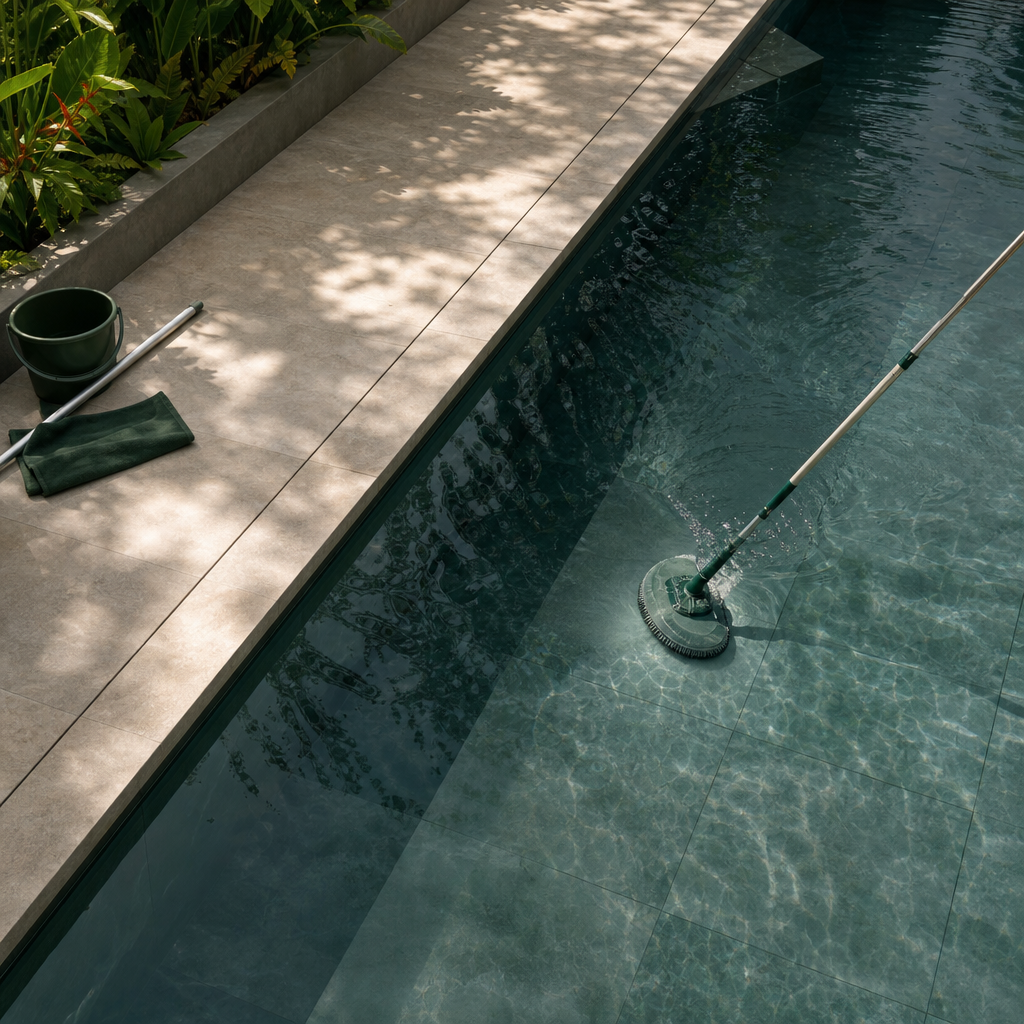
Hygiene follows the same logic: marble is a natural mineral surface but can hold stains in micro-pores if neglected, while porcelain’s dense, non-porous body is easy to sanitise and holds up in demanding environments. For sun-exposed or outdoor settings, marble is more vulnerable to weathering and repeated thermal shock, whereas porcelain is a strong candidate for outdoor kitchens and sun-flooded rooms where heat and UV are the challenge.
How the Iraqi context changes the decision
Countertops in Iraq work against a specific set of conditions: high ambient temperatures and strong sun across many regions, cooking that leans on oil, spices, tea and coffee with frequent hot pans, dust and regular cleaning near balconies and open kitchens, and a project mix that runs from villas and towers to hospitals and hospitality spaces.
Those conditions tilt the everyday-use case toward hard, non-porous, heat-resistant materials, which is exactly where porcelain performs strongly. That said, projects built around timeless luxury and natural variation — with clients who welcome patina and are ready to maintain it — can still justify marble, particularly on feature islands, powder rooms, or reception counters where heavy cooking and harsh cleaning are rare. For healthcare and clinical settings specifically, the priorities shift again toward easily sanitised, chemically resistant surfaces, a theme we explore in our overview of surface materials for hospital interiors in Iraq.
When marble makes sense, and when porcelain does
Marble earns its place when natural stone authenticity is non-negotiable and the client wants the depth, variation, and tactile feel of real stone even at the cost of extra care. It suits prestige-focused rather than high-traffic spaces — reception desks, powder rooms, formal dining areas — where heavy cooking and strong cleaning agents are uncommon. It works where users accept patina and have the budget and time for periodic sealing and gentle cleaning, treating gradual wear as a design feature. And it reads intuitively in interiors leaning toward warm, classical, hotel-like atmospheres.
Porcelain makes more sense when durability and easy care come first: busy family kitchens, compact apartments, and commercial food spaces benefit from a surface that resists scratches, stains and harsh cleaners without sealing. It is the safer choice where heat and sunlight are significant, such as outdoor kitchens, open balconies, or sun-flooded interiors. It supports modern, minimalist and Scandinavian design intent, where large, thin slabs with controlled patterns keep visuals calm and pair naturally with modern cabinetry and lighting — the same restraint we describe in our notes on Scandinavian design principles. And it delivers consistency across large projects, letting developers of towers or villa compounds repeat one look across many kitchens and bathrooms without the natural variation of stone.
When neither is the right answer
Some briefs point elsewhere. Ultra-heavy commercial cooking with constant pan impact may be better served by stainless steel or extremely dense stones like granite or quartzite, which also rank highly for heat resistance. Clients who need integrated, moulded sinks and seamless backsplashes may find certain solid-surface or engineered composites do what marble and porcelain cannot easily match. And on very tight budgets, or where frequent future remodelling is expected, more economical surfaces chosen for quick replacement can be the pragmatic call.
In each of these cases the marble-versus-porcelain question is still part of the conversation, but the wider project brief may push the final decision toward a different material altogether.
Shortlisting materials for your project
Once the direction is clear — natural marble patina or low-maintenance porcelain — the practical work is to match materials to real spaces. Define the usage profile of each countertop, whether it is a family kitchen, a show kitchen, a bathroom, a reception counter, or an outdoor run. Decide how much visible wear is acceptable across five to ten years. Align the surfaces with the overall interior language and with adjacent finishes like flooring, wall tiles and lighting; if lighting is still open, our guide to types of lighting for home interiors helps frame that alongside the surface choice.
From there, the most reliable step is to review actual slabs, edge details and finishes in person against your specific rooms. We work with homeowners, designers and developers across Iraq to do exactly that, drawing on project references for towers, villas and hospitals so the decision stays grounded in the space rather than in theoretical pros and cons. Tell us the room, the usage, and the design language, and we can prepare a shortlist tailored to it.
Frequently asked questions
Are marble countertops practical for a busy Iraqi family kitchen?
Marble can be used in family kitchens, but in high-use, high-heat settings with frequent acidic foods and strong spices it will show scratches, stains and etching unless it is carefully maintained with regular sealing and gentle cleaning habits.
Will porcelain slabs fade or crack in our sun and heat?
Porcelain slabs are fired at very high temperatures and engineered for strong heat and UV resistance, which makes them suitable for sun-exposed interiors and many outdoor applications when they are properly installed and supported.
Do porcelain marble-effect slabs look real enough for luxury villas?
Modern porcelain achieves very convincing marble and stone-look surfaces, often in large formats with subtle patterns that read as premium and controlled, which fits minimalist and Scandinavian-inspired interiors particularly well.
How often does a marble countertop need resealing?
Typical guidance is periodic resealing, often annually or more frequently in heavy-use kitchens, to reduce staining and make daily cleaning easier; exact intervals depend on how the surface is used and the specific product.
Can I put hot pots directly on porcelain or marble?
Both handle moderate heat, and porcelain is among the most heat-resistant surfaces, while marble can be damaged by extreme heat and thermal shock. Using trivets or stands is still recommended to protect finishes and joints.