No products in the cart.


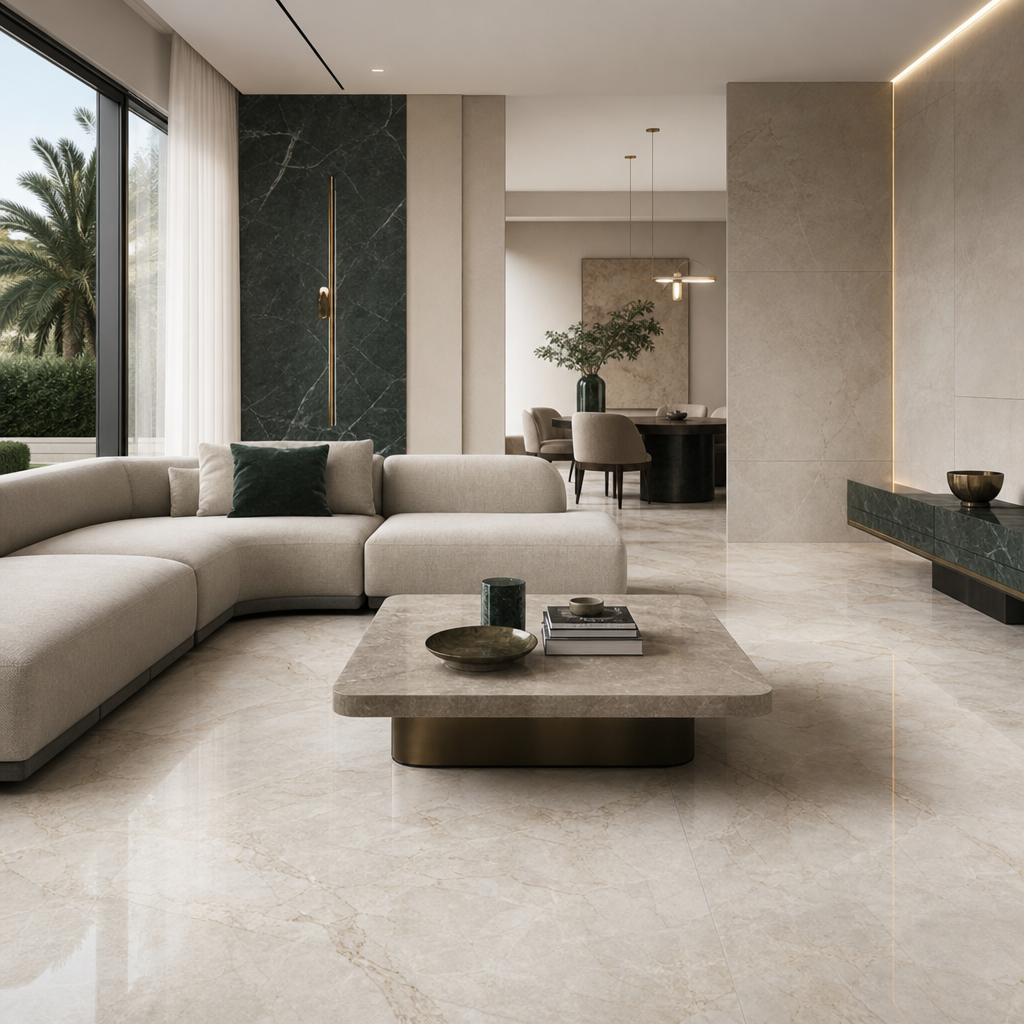
Porcelain tiles for living room Iraq are a dense, low-absorption ceramic surface fired at high temperature, giving a water absorption rate at or below 0.5%. That density is exactly why they suit Iraqi living rooms: they shrug off daily foot traffic, resist stains from spills, and stay easy to clean in dusty, air-conditioned interiors. At Agata Iraq, we curate porcelain and stone-look surfaces built around modern, minimalist and Scandinavian living spaces.
This guide explains what porcelain actually is, how the main variants differ, and the judgment criteria that separate a good living-room choice from a mismatch. We keep pricing and installation out of scope on purpose, and point you to the right next step when you are ready to decide.
Table of contents
- What porcelain tile is and how it performs in a living room
- Types and variants worth knowing
- Why porcelain matters for Iraqi homes and projects
- What to consider before you choose
- Designing your living room with us
- Frequently asked questions
What porcelain tile is and how it performs in a living room
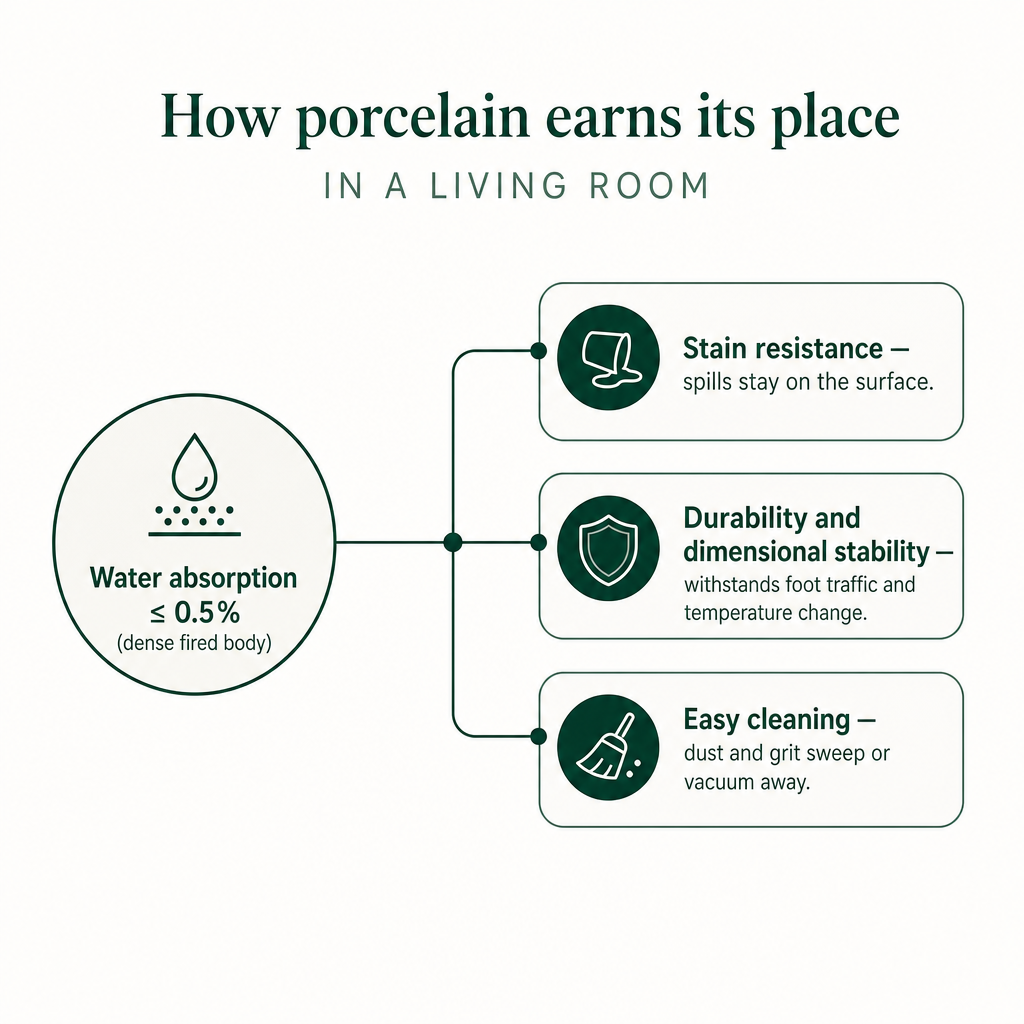
Porcelain is a subtype of ceramic tile made from refined clay fired at higher temperatures than standard ceramic. The result is a denser body with a water absorption rate at or below 0.5%, and that single property drives most of its practical advantages. Low absorption means the tile does not soak up spilled tea, coffee or cleaning water, so stains sit on the surface rather than penetrating it.
The same density improves durability and dimensional stability. In a living room, this translates into a floor that holds its shape and finish under years of foot traffic, furniture movement and seasonal temperature swings. Because the surface is hard and closed, dust and grit sit on top and lift away with a sweep or vacuum instead of grinding into the material.
One distinction matters before anything else: porcelain is defined by its body and absorption rate, not by its look. A stone-look, concrete-look or wood-look tile can all be porcelain, and the visual effect tells you nothing about performance on its own. Performance comes from the fired body, the surface rating and whether the manufacturer designates the tile for floor use.
Types and variants worth knowing
Porcelain for living rooms splits along three axes: size, finish and visual effect. Understanding how each one changes the room helps you brief a showroom accurately instead of choosing on a single sample.
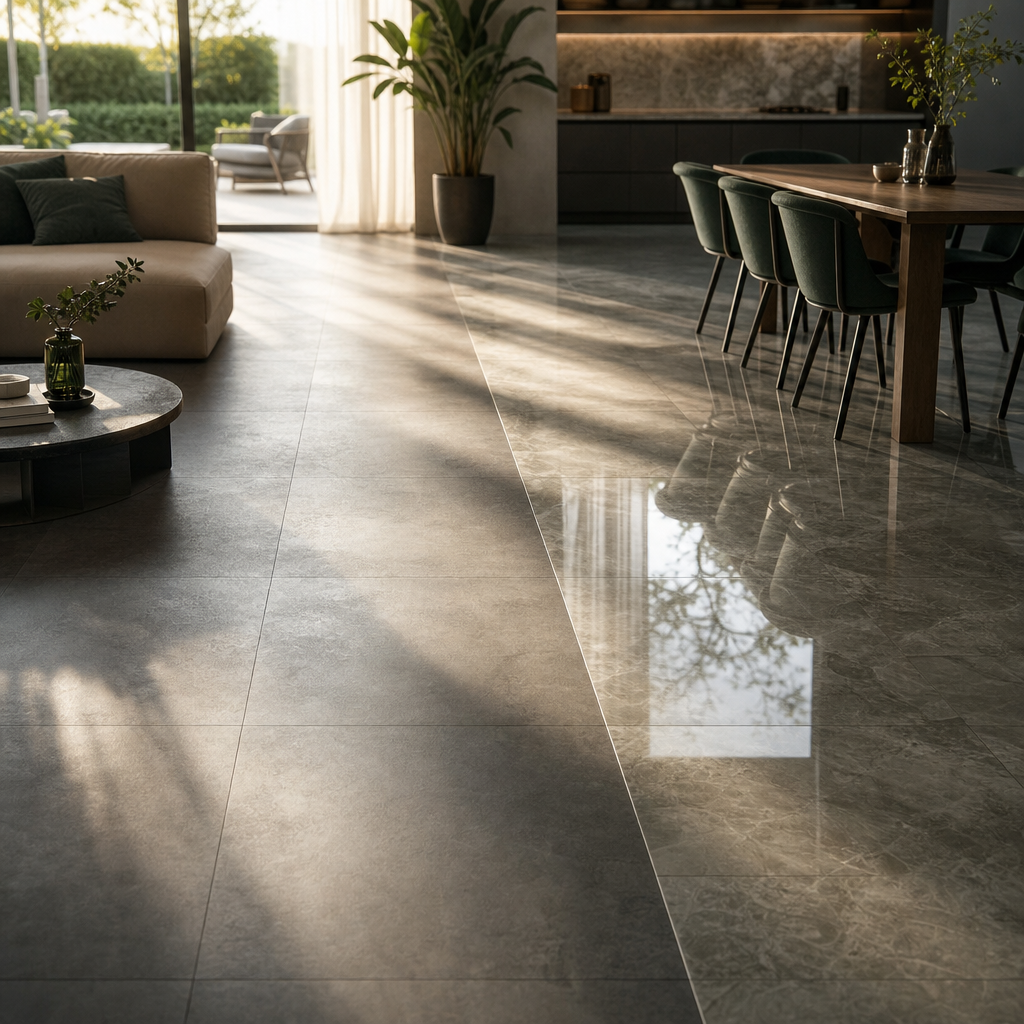
Size and format. Large-format porcelain, commonly around 600 × 1200 mm, is repeatedly singled out for living rooms, hallways and open-plan spaces. Fewer grout lines produce a more seamless surface that reads as calmer and more spacious, which is why large formats suit modern layouts. Standard and smaller formats remain useful for compact rooms or where a more patterned, defined layout is wanted.
Finish and texture. Finish changes both look and behaviour:
- Polished and semi-gloss finishes give a luxury, reflective feel and bounce light around a room.
- Matte and lightly textured finishes are more muted and help disguise dust and minor surface marks in high-use homes.
- Structured surfaces add grip where slip resistance matters, such as a living room that opens onto an entrance or balcony.
Visual effect. Porcelain is produced in stone-look, concrete-look, wood-look and abstract contemporary patterns, so it can carry almost any design scheme. In our range, a stone-look surface such as TRAVERTINE SILVER leans toward a warm, hotel-style or Mediterranean feel, while a cleaner contemporary porcelain like ABSTRA sits closer to minimalist and Scandinavian interiors. Treat these as illustrations of the effect families, not as the only options.
Why porcelain matters for Iraqi homes and projects
The Iraqi living room places specific demands on a floor, and porcelain answers most of them directly. Dust and sand are a near-constant reality in many cities; a dense, closed surface keeps grit on top and preserves appearance with a simple cleaning routine rather than deep restoration. Interiors that cycle between hot outdoor conditions and cooled indoor air also benefit from porcelain’s dimensional stability.
Open-plan living, dining and entertaining spaces are common in newer villas and apartments, and large-format porcelain supports that visual flow by reducing grout interruptions across a wide floor. Our project references span towers, villas and hospitals, so the performance thinking we apply to high-traffic and prestige interiors carries straight into a family living room.
There is also an aesthetic reason porcelain matters here. A living room floor is the largest single surface in the room and sets the tone for everything above it. We design around modern, minimalist and Scandinavian schemes, which means the floor is chosen in relation to the sofas, dining tables, beds and lighting it will live with, not in isolation. That coordination is where a curated surface earns its keep.
What to consider before you choose
The right living-room porcelain is a set of trade-offs, not a single winner. These are the criteria to weigh, and the misconceptions worth clearing up before you commit.
Floor rating, not just the look. A common assumption is that any porcelain works on any floor. It does not. Some porcelain is intended for walls and carries lower wear resistance. Check the durability class and the Porcelain Enamel Institute (PEI) wear rating: independent guidance points to PEI 3–4 as the typical band for residential living-room and hallway floors, with 4 to 5 relevant for heavier traffic, large families or mixed residential and commercial use. Confirm the manufacturer designates the tile for floor use.
Size against the actual room. Large format flatters bigger, open rooms and creates depth; it can overwhelm a small, boxy space. Match the format to the room’s proportions and to how open the layout is, rather than defaulting to the largest tile available.
Finish versus maintenance. Gloss level and safety are often confused. The relevant safety measure is the slip resistance rating, not whether a tile looks shiny. Polished tiles can meet acceptable slip standards in a dry living room; the real risk rises in wet or outdoor zones. If your living room connects to an entrance, balcony or pool area where wet footprints arrive, weight the finish toward grip. In dusty homes, matte and textured finishes also hide day-to-day marks better than high gloss.
Do large tiles crack in the heat? There is no blanket rule that large formats fail in hot climates. Porcelain’s dense body and low absorption actually help dimensional stability. The variables that decide long-term results are correct substrate and installation, which sit outside this guide.
Colour, light and coordination. Choose colour and effect in relation to the room’s natural and artificial light and the furniture it will sit beneath, so the surface does not visually shrink the space. This is the criterion most often skipped when tiles are picked from a small sample under showroom lighting alone.
Use examples like ABSTRA to picture a contemporary scheme and a stone-look surface to picture a warmer one, then let a room-level assessment confirm the fit.
Designing your living room with us
Once the criteria are clear, the decision becomes a matter of matching a specific surface to your room, your traffic and your furniture. You can browse porcelain and stone-look surfaces together on our tile and surface shop, and review the manufacturers we work with on our brand partners page to understand the quality and testing standards behind each collection.
Because specification detail such as exact formats, finishes and floor ratings varies by collection, the most reliable next step is to tell us your room size, layout, expected traffic and the look you want. From there our team confirms living-room suitability and coordinates the tile with the furnishings and lighting around it. When you are ready for the technical side, installation sequencing is covered separately in our how-to guidance rather than here.
Frequently asked questions
Are porcelain tiles good for a living room in Iraq?
Yes. Their dense, low-absorption body resists stains, handles daily foot traffic and cleans easily in dusty conditions, which suits Iraqi living rooms well.
What PEI rating should living-room porcelain have?
Independent guidance points to PEI 3–4 for typical residential living rooms and hallways, moving toward 4–5 where foot traffic is heavier.
What size porcelain tile suits a living room?
Large-format porcelain, commonly around 600 × 1200 mm, is favoured for living rooms and open-plan spaces because it reduces grout lines and feels more spacious. Smaller formats suit compact rooms.
Is polished porcelain too slippery for a living room?
Not necessarily. Safety depends on the slip resistance rating, not gloss alone. Polished tiles can be fine in a dry living room; grip matters more where wet footprints arrive from an entrance or balcony.
What is the difference between porcelain and standard ceramic tile?
Porcelain is fired denser and absorbs 0.5% water or less, making it more durable and stain resistant than standard ceramic. Check the water absorption rate in the technical data to confirm.