No products in the cart.


Anyone pricing a renovation or a full development in Iraq quickly hits the same wall: there is no honest single number for porcelain tiles price Iraq that survives contact with a real project. Broad market data puts porcelain roughly in the IQD 15,000–35,000 per m² band (figures dated March 2026, Iraqi Dinar), but that baseline says almost nothing about what a curated, design-led collection will cost once size, finish, technical grade and installation scope enter the picture. At Agata Iraq we quote our premium porcelain individually rather than publishing fixed per-m² lists, so the most useful thing we can do here is show you exactly how a figure is built and what we need to give you a precise one.
Table of contents
Why a single price per m² is not reliable for our porcelain
We run a premium, design-led showroom for tiles, slabs and interior finishes, not a discount tile warehouse. Our porcelain ranges include stone-look surfaces such as Travertine Silver alongside curated collections specified for villas, towers and hospital projects. Those are very different products from generic imports, and their prices move with the exact series chosen, the tile format, the finish, the technical performance and the order volume.
Because none of these premium series carry a public price-per-m² on our site or catalogues, there is no single defensible range that fairly covers every project. A 60×60 matte floor for a compact apartment and a 60×120 polished stone-look surface running through a villa are not the same commercial conversation, even when both are “porcelain.” That is why we prepare tailored quotations once your product choices and project details are known, rather than anchoring you to a number that would be wrong more often than right.
The Iraq market baseline for 2026
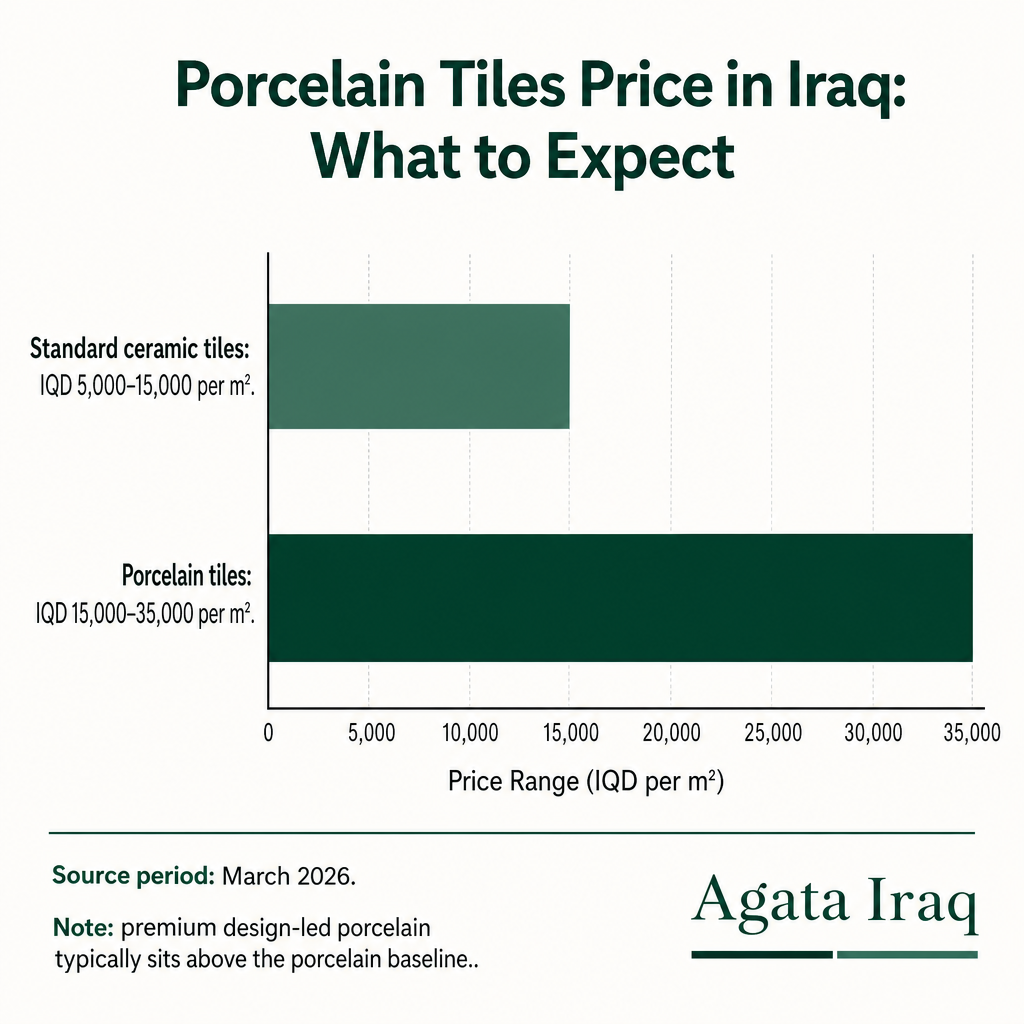
Before adding the showroom and project layers, it helps to see where the wider market sits. A recent overview of ceramic and porcelain tiles for Iraq reports standard ceramic tiles at roughly IQD 5,000–15,000 per m² and porcelain tiles at roughly IQD 15,000–35,000 per m² (average costs in Iraqi Dinar, data updated March 2026). Porcelain sits above basic ceramic in that data because of its higher durability and water resistance.
Those numbers describe typical market-level pricing, not curated design ranges. For our premium porcelain, expect pricing to sit above entry-level ceramic and often above generic porcelain imports, because the final figure reflects design value — aesthetic, brand and format — as much as raw material and manufacturing. Treat the market band as a floor for expectations, not a ceiling, and never as a substitute for a real quote.
What actually moves your porcelain quote
Six elements do most of the work in shaping a final figure. Understanding them lets you read any quote critically instead of comparing surface numbers.
Tile type and performance. True porcelain is vitrified with very low water absorption; it uses denser clay, higher firing temperatures and stricter quality control than standard ceramic, which raises its cost. Outdoor or high-traffic porcelain with higher slip resistance and wear ratings adds more, because it must meet more demanding technical standards.
Size and format. Regular formats such as 30×60 and 60×60 are usually more economical per m² than large-format pieces like 60×120 and slab-like tiles, which need more advanced manufacturing and careful handling. Large formats reduce grout lines and read as more luxurious, but they lift both material and installation costs.
Finish and look. Polished, lapped and special textured finishes cost more than a simple matte glaze because they add production stages. Stone-look surfaces such as our travertine-inspired designs, and advanced digital printing, are priced above plain single-colour options.
Brand and collection position. Design-led collections built around modern, minimalist or Scandinavian aesthetics carry a premium over generic tiles, reflecting the design development behind them. Limited series can sit at the upper end of the porcelain range.
Volume and project type. Large orders for towers, villa compounds or hospitals are quoted as project pricing that weighs logistics, stock continuity and bundled solutions such as tiles with slabs and bathroom fittings. A single kitchen or bathroom may face a higher per-m² figure but gains curated advice and showroom service.
Logistics and import conditions. Iraq imports large volumes of ceramic and porcelain, so shipping, duties and currency movements shape the landed cost per m² before any retail margin. We reflect those variations inside each project quotation rather than freezing static list prices that would drift out of date.
What a price includes and what sits outside it
A figure only means something once you know what it covers. When you receive a porcelain price, first establish whether it is material-only or supply-and-install.
A material-only price per m² usually covers tiles boxed at factory standard and excludes installation. It may or may not include trims and skirting, depending on how the quote is built. A supply-and-install package adds labour for substrate preparation, laying, grouting and basic site cleaning, and those labour rates vary by city, installer skill and complexity such as patterns, large formats or staircase work.
For a premium supplier, the default figure you will receive from us is typically material-only, with installation handled either by your contractor or a partnered team under a separate line item. That separation is deliberate: it keeps the material comparison clean.
Check these common exclusions explicitly before you sign anything:
- Demolition of old tiles and removal of waste
- Subfloor repairs, levelling or waterproofing
- Special trims, profiles and step nosings
- High-performance adhesives and grouts for heavy-duty areas
- Design services beyond a basic layout, such as a full interior concept
The more customised your solution, the more valuable it is to separate material, installation and specialist items into distinct lines.
Comparing offers on a genuine like-for-like basis
Headline price per m² is the least reliable way to compare tile offers, because it hides what you are actually buying. Align the specification first, then look at the number.
Our strength sits in curation rather than raw catalogue volume: we select ranges that hold together as modern, minimalist and Scandinavian interiors, presented through our porcelain and stone-look collections. That reduces the time you spend sorting low-contrast options and raises the odds of a coherent finished look. Stone-look pieces such as Travertine Silver show the emphasis on natural-stone surfaces for calm, spa-style bathrooms and living spaces, and those looks are usually more sophisticated than standard printed tiles, which is where a higher material cost earns its place in a finish budget. If you want to understand the surface category itself before comparing, our guide to porcelain slabs explains how these products differ from ordinary tiles.
When you have two quotes in hand, normalise them before judging price:
- Match tile type — true porcelain against true porcelain, not porcelain against ceramic.
- Match size and finish, for example 60×120 stone-look matte against the same, not against 60×60 plain gloss.
- Confirm whether each price includes VAT, delivery and any installation services.
- Confirm brand and collection positioning, because a mass-market line is not equivalent to a premium, design-led series.
Only once those four are aligned does the comparison of the actual figures mean anything.
The inputs we need to quote your project
A precise, itemised quote depends on precise inputs. The more of the following you can supply, the faster we can distinguish costs zone by zone rather than quoting a vague average.
- Project type and location. Apartment, villa, tower, clinic, office or hospitality space, plus city and neighbourhood, which affect logistics and installation planning.
- Areas and approximate sizes. Floor and wall areas in m² for each room — kitchen, bathrooms, living spaces, corridors, outdoor terraces — with special zones like showers, stairs or pool surrounds flagged separately.
- Intended usage and durability needs. Residential versus commercial foot traffic, wet versus dry areas, indoor versus outdoor, and any anti-slip or specific technical requirements such as hospital corridors.
- Preferred aesthetic and collections. Modern, minimalist, Scandinavian, stone-look, concrete-look or marble-inspired surfaces, and whether you want consistent flooring throughout or contrasting looks per room.
- Installation scope. Supply-only or supply plus installation, and whether demolition, levelling, waterproofing or specialist details are needed.
- Timeline and budget envelope. A planned start date, a completion deadline and a realistic material budget range so we can steer you toward the right collections.
With those details clear, we can structure a quote that separates the porcelain figure for each zone from any additional services. If you are early in the process, browsing our brand and collection pages is a practical way to narrow the aesthetic before measurements are final.
Frequently asked questions
Why are porcelain tiles more expensive than ceramic in Iraq?
Porcelain uses denser, higher-quality clays and is fired at higher temperatures, giving it very low water absorption and stronger durability. That higher production standard raises its cost compared with standard ceramic tiles.
Is IQD 15,000–35,000 per m² enough for premium porcelain?
That range reflects broad-market porcelain pricing in Iraq as of March 2026. For premium, design-led collections in our showroom, your actual figure may sit above this baseline once brand, finish and project services are factored in.
Do you publish your porcelain tile prices online?
Our website showcases collections, brands and project inspiration rather than list prices per m². We provide pricing through a direct quotation based on your specific project details.
Can I get a single all-in price for my bathroom or kitchen?
Yes, but it combines material and installation and needs accurate area measurements, substrate condition and your chosen collections. Our team can outline the supply cost and coordinate with installers for the labour component.
How do I control porcelain costs without sacrificing design?
Shortlist one or two main collections that fit your aesthetic, use premium porcelain in key areas such as the living room and master bathroom, and consider more economical formats or finishes in secondary spaces. This keeps the design impact while managing total m² cost.
When you are ready for a realistic figure rather than a market estimate, the next step is simple: gather your room sizes, preferred looks and basic technical needs, and we will prepare an itemised quote that separates material, installation and any specialist extras.