No products in the cart.


The main types of lighting for home interiors are ambient, task, accent and decorative lighting, and the homes that feel right use them together in layers rather than choosing one over another. The question worth asking before you buy a single fixture is not “which lamp,” but how a room should feel and function at different times of day. That framing changes everything, because it turns lighting from a shopping list into a design decision that sits right next to your choice of tiles, slabs, bathroom fittings and furnishings. Get that pairing right and a space reads as considered and calm; get it wrong and even beautiful materials look flat.
For an Iraqi home or project, the useful goal is to combine these lighting types with the finishes you have already fallen for, so a modern, minimalist or Scandinavian scheme still works with local climate, energy realities and the way daylight behaves here. Below we explain each lighting type, the mechanisms that make them work, and the decision criteria that matter most for residential and commercial spaces in Iraq.
Table of contents
What decision are you really making?
When you choose lighting, you are really deciding how each space should perform and feel across the day, not just how it should look switched on at night. A good interior lighting scheme has four practical jobs: it makes the room safely and clearly visible, it supports specific activities such as cooking, reading, grooming or receiving guests, it highlights the design elements you invested in, and it shapes mood from warm and intimate to crisp and energetic.
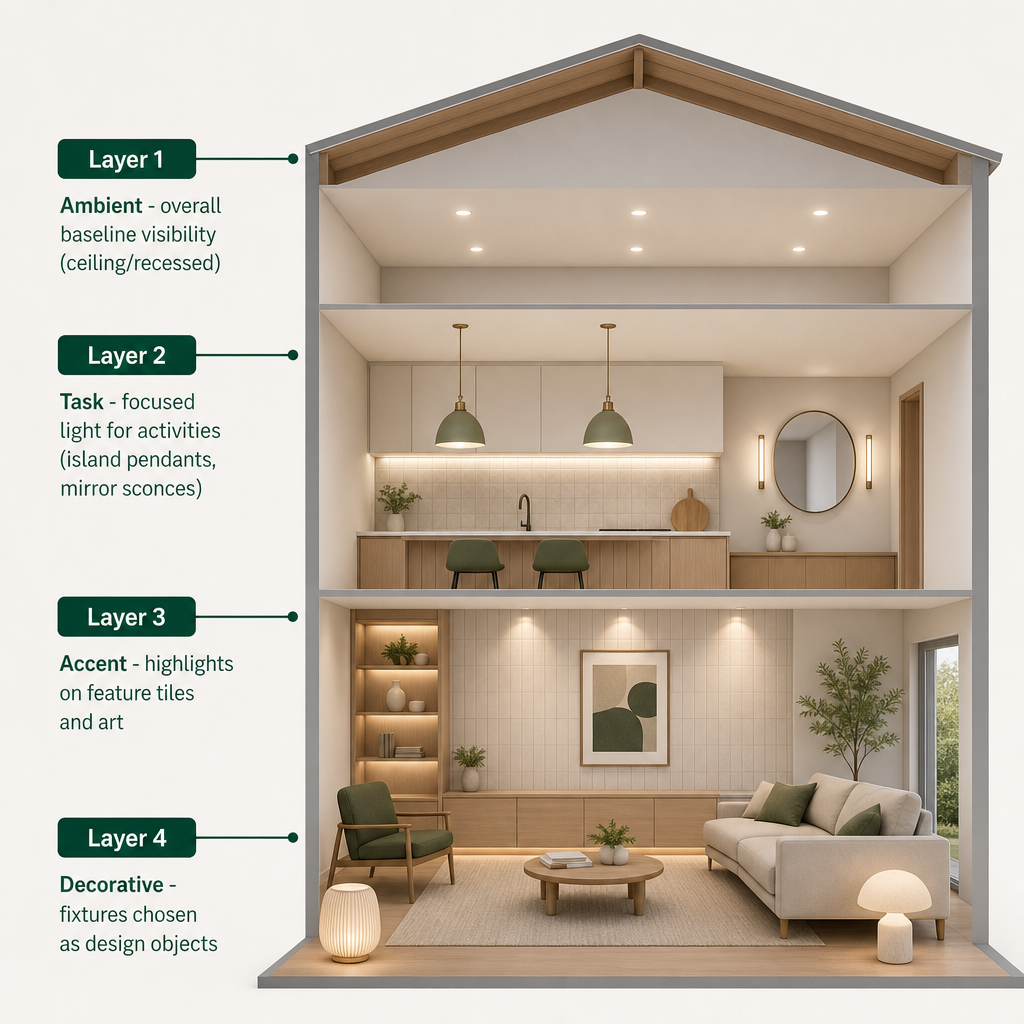
Most contemporary interiors, including Scandinavian-style spaces, solve all four at once by layering ambient, task and accent lighting, with decorative fixtures placed as deliberate focal points. Layering is the mechanism that lets one room shift from a bright family kitchen at breakfast to a softer, more relaxed space in the evening. Once you see lighting as layers with jobs, the individual fixtures become easy to choose.
The main types of lighting for home interiors
Ambient (general) lighting
Ambient lighting is the primary, overall illumination that lets people move safely and orient themselves in a room. It is meant to be moderate, even and glare-free, and it usually comes from ceiling-mounted fixtures, chandeliers and large pendants, recessed downlights or track systems, or wall-mounted fixtures that wash light across surfaces.
Ambient light is the most fundamental layer, and it often sits around a neutral 3000–4000 K so the room feels comfortable yet clear. In Iraqi interiors that neutral base is forgiving: it flatters cool stone-look tiles and warmer wood or textile finishes equally, which matters when your palette mixes porcelain floors with soft furnishings.
Task lighting
Task lighting provides focused, brighter illumination for specific activities, and here clarity and accuracy matter more than atmosphere. Think under-cabinet lighting and pendants over a kitchen island, desk and reading lamps beside seating, and mirror-side sconces or downlights in bathrooms for grooming.
Because its job is precision, task lighting is typically brighter and more directional than ambient light, and it works best positioned close to the surface so it does not throw shadows across the very work it should reveal. For detailed activities, guidance for Iraqi residential contexts targets average illuminance around 500 lux at the work surface, which keeps close visual tasks comfortable without turning the whole room into a workshop.
Accent lighting
Accent lighting adds drama and focus by drawing the eye to specific elements: feature tiles, wall textures, artwork, plants or niche shelving. The usual tools are adjustable spotlights and track heads aimed at a feature, wall sconces that graze textured tile or stone, and recessed or strip lighting tucked into niches, behind mirrors or under benches.
What makes accent lighting work is contrast. It is more intense at the focal point than the surrounding ambient light, so the eye is led to the feature without the whole room being over-lit. This layer is unusually powerful in tile-centric spaces. A grazing beam across a stone-look shower wall, a living-room feature wall or a travertine-style floor reveals veining and relief that flat overhead light hides entirely.
Decorative lighting
Decorative lighting refers to fixtures chosen first as design objects that also happen to give light: chandeliers, sculptural pendants, statement floor lamps. They may deliver ambient or accent light in passing, but you select them for form, material and the style they announce, whether that is minimalist, luxurious, Scandinavian or classic.
In our showroom context, decorative pieces frequently act as the visual bridge between hard surfaces and soft ones, tying porcelain or stone-look tiles to the sofas, dining tables and beds around them. A single well-chosen pendant over a dining table can settle an entire room’s identity.
Natural and reflected light
Daylight from windows and openings is part of the ambient layer, and it interacts strongly with your interior surfaces. Technical guidance for Iraqi interiors emphasizes keeping high reflectance on ceilings, often above 70%, with moderate reflectance on walls and floors so daylight spreads evenly, and it warns against extreme brightness ratios that tire the eye when a bright window sits against a dark interior.
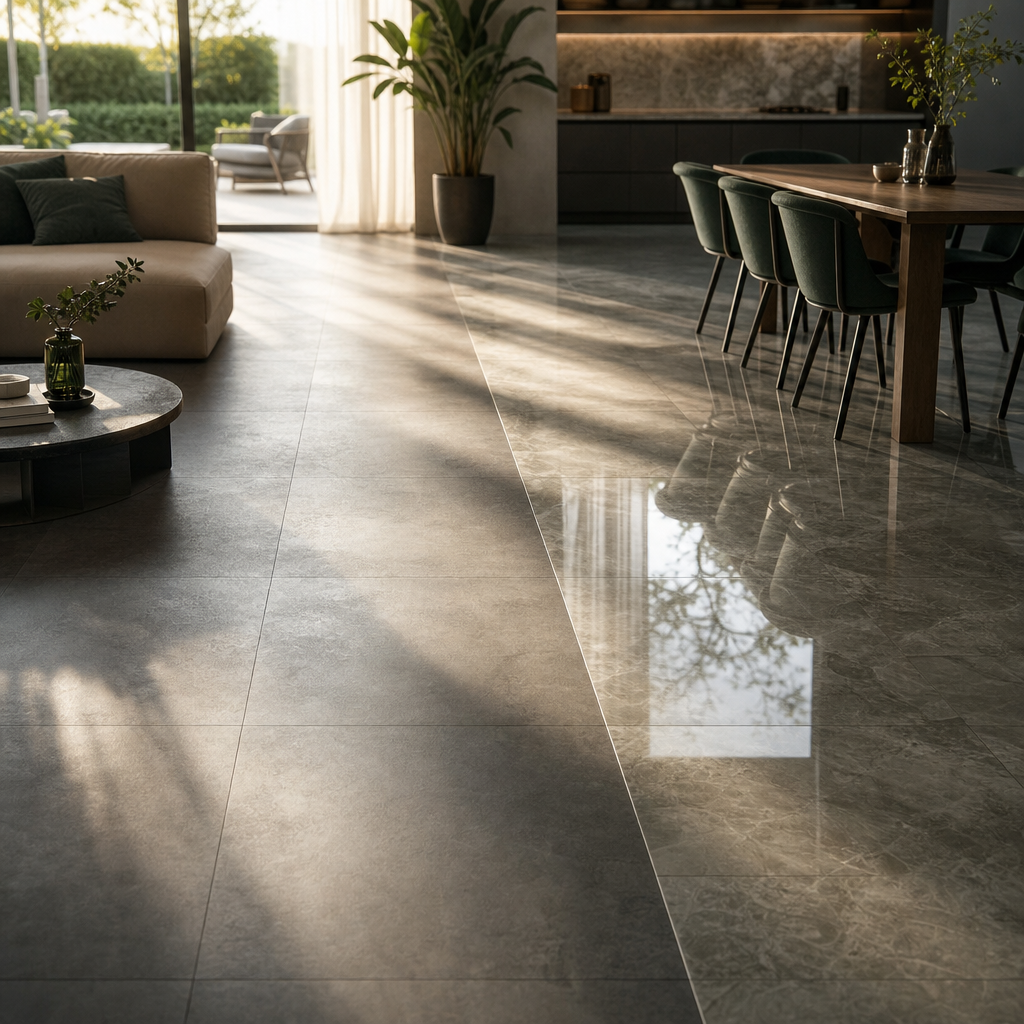
Porcelain and travertine-look tiles with mid-range reflectance help balance this. They bounce enough light to brighten a room without producing harsh glare, particularly in matte finishes, which is why finish and light behaviour deserve to be discussed together rather than after the tiles are already down.
Mechanisms: brightness, color temperature and reflection
Brightness (lux) and visual comfort
Brightness in rooms is usually described in lux, meaning lumens per square metre, and it is the clearest way to judge whether a layer is doing its job. Research on Iraqi residential lighting offers useful anchors: occupied spaces without detailed work should not fall much below about 30 lux, or they start to feel unsafely dim, while reading and work areas benefit from far higher levels, around 500 lux, when modern LED fixtures are used. The same work notes that upgrading from traditional lamps to well-designed LED systems can improve lighting energy efficiency by roughly 60% in typical Iraqi homes when the fixture layout is optimized.
The point is not to make every room uniformly bright. It is to let each layer contribute its share: ambient sets the baseline, task adds intensity where hands and eyes are busy, and accent concentrates brightness on the features worth showing off.
Color temperature (warm vs neutral vs cool)
Color temperature changes both mood and how your materials read. Warm white around 2700–3000 K feels cozy and tends to suit living rooms and bedrooms, while neutral white around 3000–4000 K supports concentration and clarity in kitchens, bathrooms and workspaces while staying comfortable.
A practical habit is to keep ambient lighting in the neutral range so skin tones, tile colours and fabrics all appear honest, then tune task and accent fixtures slightly warmer or cooler to match the activity and the style you are after. A stone-look tile that looks crisp under neutral downlights can turn noticeably warmer and softer under a 2700 K accent, so the temperature choice is really a mood choice.
Reflection and materials: why tiles matter
Light never exists on its own; it interacts with every surface it lands on. Technical recommendations for interior lighting stress ceiling, wall and floor reflectance precisely because those surfaces decide how evenly light is distributed. Light matte ceilings and walls bounce ambient light and reduce the number of fixtures you need. Stone-look and porcelain tiles with subtle texture, such as travertine-effect surfaces or soft concrete-look finishes, break up reflections so floors and walls read as rich rather than glaring. Highly glossy surfaces can be beautiful under carefully controlled accent lighting, but they punish careless over-lighting with hotspots.
This is why tile selection and lighting design belong in the same conversation. A silver-toned travertine-look floor behaves very differently under warm accent spotlights than under neutral downlights, so the pairing should follow the mood and function you want, not chance. If you are still narrowing surfaces, our travertine-effect tile and large-format porcelain series are useful starting points to test against different light temperatures in person, and sealing matters too, as covered in our guide on how to seal travertine tiles properly.
Decision criteria for Iraqi homes and projects
Energy efficiency and future-proofing
Electricity cost and reliability make efficiency a core decision, not an afterthought, in most Iraqi homes and projects. Studies of residential lighting in the country conclude that moving from traditional fixtures to LED systems and optimizing the layout can raise lighting efficiency by around 60% while keeping brightness adequate. In practice that means choosing LED fixtures for almost all ambient, task and accent lighting, adding dimmers and zoning so not every light runs at full power at once, and favouring integrated LED strips and recessed downlights where a minimal, discreet installation suits a modern interior.
Comfort in a bright climate
Strong daytime sun and variable night-time conditions mean interiors here must manage daylight and artificial light together. Guidance for Iraqi contexts stresses avoiding extreme luminance contrasts and keeping a comfortable minimum illumination in every occupied space. Two moves help most: use ambient lighting that can be adjusted between day and night, especially in living rooms and open-plan areas, and pair light-reflective but not overly glossy tiles with neutral ambient light so windows do not create glare against darker interior zones.
Room-by-room priorities
The balance of lighting types shifts from room to room even inside one apartment or villa.
| Room | Ambient | Task | Accent |
|---|---|---|---|
| Living room | Warm, adjustable base | Reading chairs | Feature wall, TV area |
| Kitchen | Safe circulation light | Bright neutral on counters, island, sink | Optional on open shelving |
| Bathroom | General safety light | Around the mirror, avoiding top-only shadows | Niches, tiled recesses |
| Bedroom | Softer overall light | Bedside reading | Headboard, wall panels, tiled niches |
The kitchen leans hardest on bright neutral task light, the bedroom on softer layers that do not disturb rest, and the bathroom on mirror-side task lighting placed so it fills in the shadows that overhead-only fixtures leave on the face.
Aesthetic coherence: modern, minimalist and Scandinavian
Scandinavian-inspired interiors, which we lean into, rely on layered warm or neutral light with no harsh glare, simple well-balanced fixtures that complement rather than dominate, and a strong interplay between natural materials and soft light. The design decision is to choose lighting that keeps that visual language calm and uncluttered: concealed strips to underline architectural lines, a simple pendant over the dining table, gentle wall washers on textured surfaces, rather than ornate or over-bright fixtures. If that direction appeals, our overview of Scandinavian design principles explains how surfaces and light reinforce each other.
How we help you plan lighting around your finishes
We work as a design-led finishing brand, bringing tiles, slabs, bathroom solutions, furniture and lighting into curated collections under one roof. That lets homeowners, designers and developers coordinate lighting fixtures with a specific tile series and bathroom solution from a single showroom, keep modern, minimalist and Scandinavian schemes consistent across surfaces and fittings, and review lighting choices next to physical tile samples so you can see how light reveals veining, texture and colour before anything is installed.
For architects and interior designers, that integrated approach removes a familiar uncertainty: lighting decisions can be matched to our project references for towers, villas and hospitals, so both technical performance and aesthetic cohesion are checked together rather than reconciled on site. If you tell us the room, its daylight, its finishes and the mood you want, we can help shape a layered plan around them.
Frequently asked questions
Which types of lighting should every home in Iraq have?
At minimum, each room benefits from ambient lighting so people can move safely, task lighting where specific activities happen such as kitchen worktops, desks and mirrors, and targeted accent lighting for key features like textured tile walls or artwork.
Are warm or neutral lights better for Iraqi homes?
Warm white around 2700–3000 K feels calm and suits living rooms and bedrooms, while neutral white around 3000–4000 K supports clarity in kitchens, bathrooms and workspaces. Most homes use both, chosen by room function.
Do I really need accent lighting if I already have bright ceiling lights?
Bright ceiling light alone tends to flatten a space. Accent lighting lets you celebrate specific design elements such as feature tiles, niches or panels without over-lighting the whole room, which gives a richer, more considered result.
Why is LED lighting strongly recommended in Iraq?
LED systems deliver the same or better brightness with significantly lower energy use, and studies of Iraqi residences show potential efficiency gains of around 60% when traditional fixtures are replaced and layouts are optimized.
How should I coordinate lighting with tiles and slabs?
Consider tile tone, finish and texture when choosing light colour and direction. Neutral ambient light keeps colours honest, while carefully positioned accent lighting reveals veining and relief on stone-look or textured tiles without glare, especially when ceiling and wall reflectance are planned in line with professional guidance.