No products in the cart.


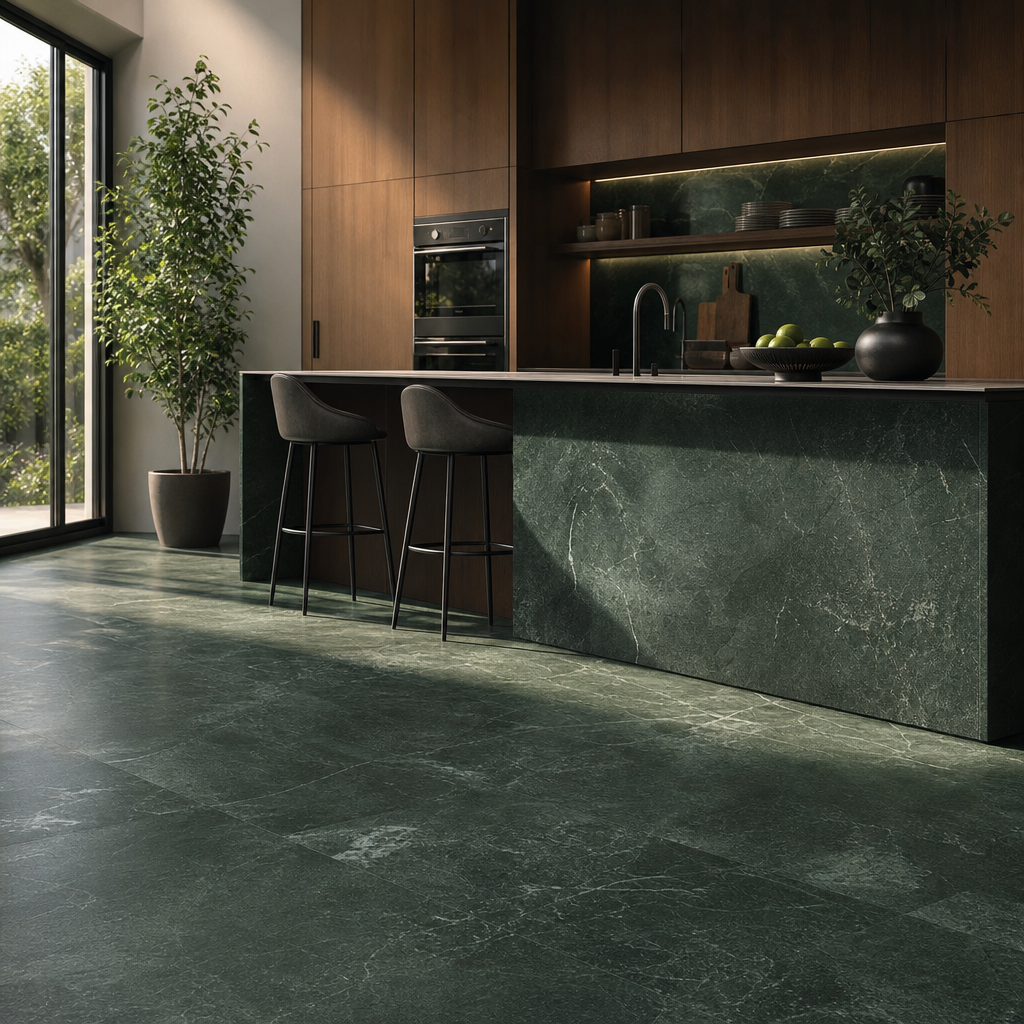
A modern kitchen floor has to do several jobs at once: shrug off cooking spills, survive dropped pans, stay safe underfoot near the sink, and flow visually into the living and dining space it almost always opens onto. That is why the best flooring for modern kitchens in Iraq tends to be dense, moisture-resistant porcelain, chosen in finishes that suit minimalist and Scandinavian interiors rather than fighting them. This list sets out the criteria we use, then works through four flooring directions from our own collection, each with its clear fit and its honest limitation, so you can match the right surface to the way you actually cook and live.
Table of contents
How this list chooses the best flooring for modern kitchens
Before naming surfaces, it helps to agree on what a modern kitchen floor is being judged against. We weigh six things in order of how much they affect daily life in an Iraqi home.
Moisture and stain resistance comes first, because kitchen floors meet water, oil and acidic spills constantly and get mopped far more than any other room. Durability and hardness matter next, for the foot traffic of a busy household and the occasional dropped pot. Slip resistance follows, concentrated in the working triangle around the sink, hob and island where water reaches the floor. Then comes visual integration, since most modern kitchens are open-plan and the floor has to read as one calm surface shared with living and dining zones. Design compatibility with minimalist and Scandinavian schemes keeps the floor supporting the room rather than competing with cabinetry and light. Finally, we only shortlist finishes available within our own curated porcelain and stone-look ranges, so what you read here is genuinely sourceable for a residential or project order.
Porcelain earns its place at the centre of this selection because of how it is made. Fired at high temperatures from fine clays, it becomes dense and low-absorption, which is the practical reason it is so widely specified for kitchens and bathrooms in Iraq. That density is the quiet engine behind stain resistance, impact tolerance and easy cleaning, and it is the common thread linking every option below.
Travertine Silver: warm travertine-look porcelain
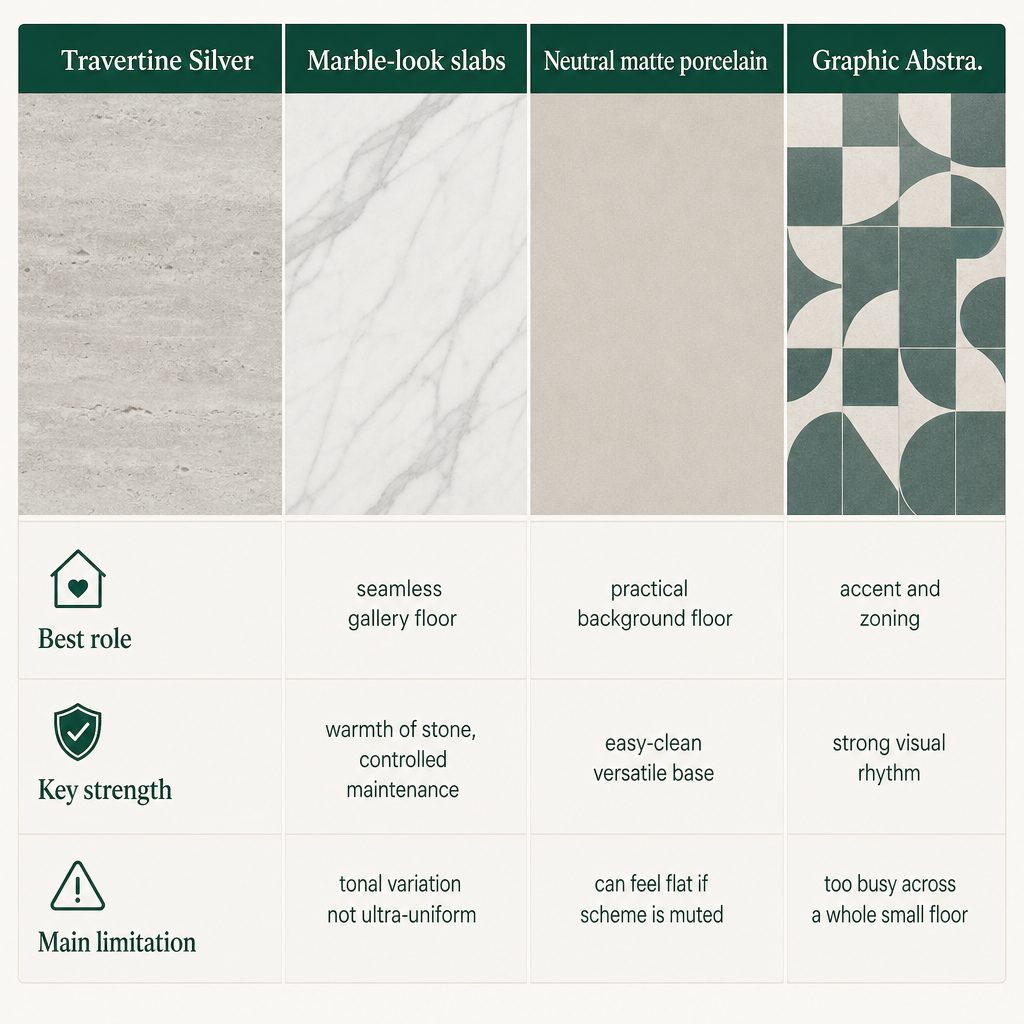
Some kitchens want to feel welcoming, not clinical. Travertine Silver answers that directly: it is a travertine-look porcelain tile that gives the warmth of stone without the daily worry and sealing demands of raw travertine. It sits between rustic and modern, carrying a Mediterranean softness that pairs naturally with oak cabinets, soft greys and Scandinavian-style lighting, while staying firmly inside our stone-inspired ranges curated for minimalist interiors in Iraq.
Its best home is the open-plan villa kitchen, where the floor has to connect visually to living and dining areas and hold them together as a single calm surface. For households that host often, a tactile, cosy floor matters as much as durability, and Travertine Silver delivers both. It is also a sensible pick for projects where designers want a natural-stone look but need to keep maintenance and budget controlled across large floor areas. Because it carries water well when correctly specified and detailed, it even appears in our wet-room and bathroom concepts, which tells you something about its tolerance in moisture-prone zones.
The limitation is inherent to the look. Tonal variation and veining are the point of a stone-look tile, so a homeowner chasing a perfectly uniform, ultra-minimal floor will be happier with a solid neutral porcelain. And like any textured stone-look surface, it rewards sensible grout choice, good sealing of joints and a steady cleaning routine to keep the micro-relief fresh in a heavy-use kitchen.
Marble-look porcelain slabs: seamless ultra-modern floors
When the brief is drama and continuity, marble-look porcelain slabs are the strongest move. These are large, vitrified panels that deliver the visual impact of marble with the performance of porcelain, and our slab collections are positioned as premium, design-led surfaces for luxury villas and contemporary interiors. Unlike quarried marble, porcelain slabs are non-porous and far more forgiving of everyday kitchen spills and cleaning products.
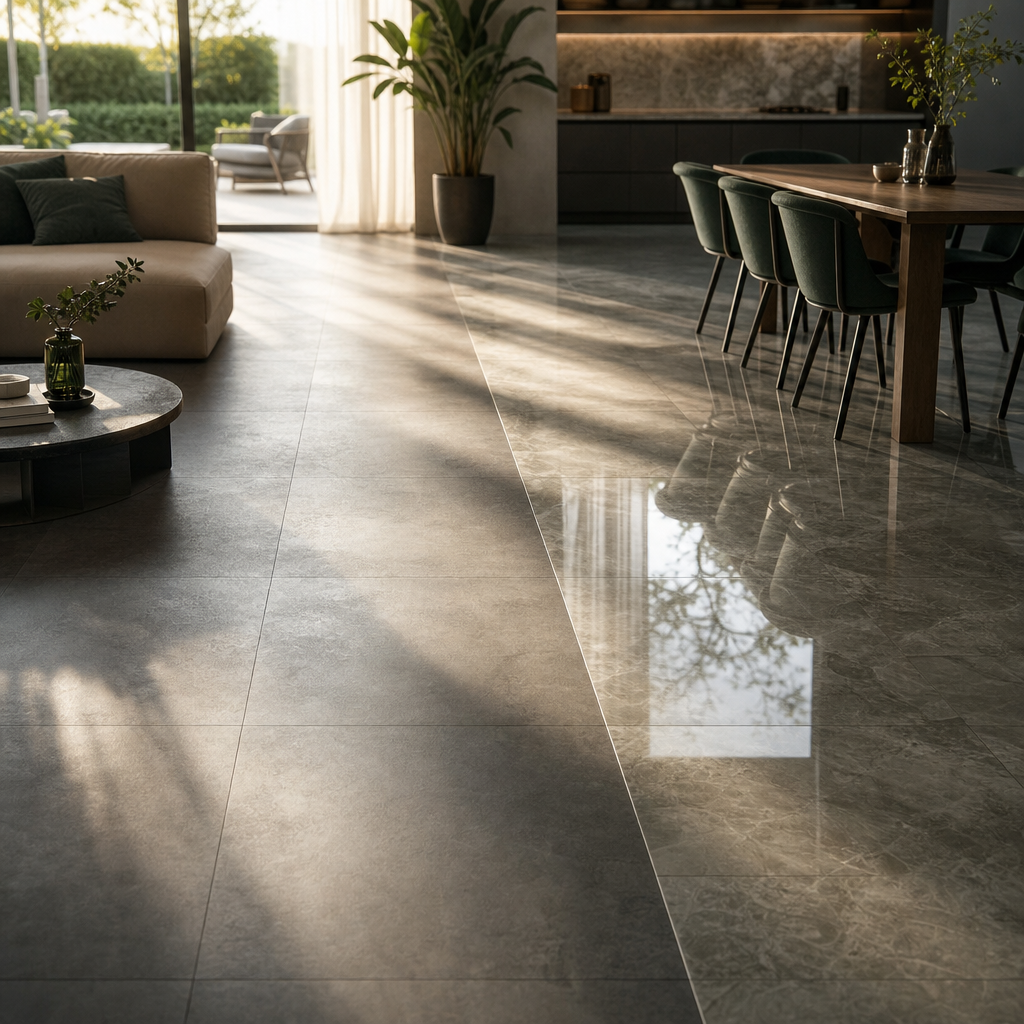
They work best in large kitchens and long open-plan spaces where a client wants a gallery-like floor running uninterrupted from the cooking zone into dining and living areas. The large format cuts the number of grout lines, which suits minimalist projects and genuinely speeds up sweeping and mopping in dusty conditions. For developers delivering towers and flagship villas, slabs can carry a luxury aesthetic while simplifying long-term maintenance compared with natural stone.
There are real constraints. Slabs demand specialist handling, careful subfloor preparation and professional installation; this is not a casual fit. Smooth finishes can be unforgiving in wet working zones unless slip resistance is specified deliberately and the layout avoids pooling around the sink or hob. Up-front material and installation costs sit above standard tile budgets, so slabs make the most sense in premium renovations and higher-spec units rather than every project.
Neutral matte porcelain: minimalist and Scandinavian-ready
Not every kitchen wants to be the star. Our broader porcelain tile ranges include neutral, matte finishes built to support minimalist and Scandinavian interiors, where light, function and honest materials lead. These dense tiles give an easy-clean, durable base that steps back and lets cabinetry, lighting and furniture carry the scheme, which is exactly what a good background floor should do.
That makes them a natural fit for apartments and family homes where the kitchen is part of a busy daily routine and needs a practical, forgiving surface. They align closely with a restrained, light-filled Scandinavian approach, and in open-plan layouts a neutral floor carried from kitchen into living areas creates a single visual field that makes the whole space feel larger and more ordered.
The trade-off is tonal risk. A neutral matte floor can feel flat when the rest of the scheme is also muted, so you may need furniture, layered lighting and texture to keep the room from reading as plain. Very light neutrals can also show dust more quickly in Iraqi conditions, so it is worth balancing the tone you love against the cleaning rhythm you will realistically keep.
Graphic Abstra porcelain: zoning and focal points
Abstra is the deliberate exception on this list. It is a graphic porcelain collection that fuses art and function, using abstract blocks and high-gloss surfaces to build strong visual rhythm. Within our editorial it reads as a contemporary counterpoint inside a neutral palette, a surface that can turn one plane into a focal feature without overwhelming a small room.
In a modern kitchen, Abstra earns its keep as a zoning and accent tool, not as the main continuous floor. It can frame an island, mark out a breakfast bar, or line the wall behind the hob to anchor the cooking zone within an open-plan layout. That is particularly valuable in apartments and compact villas where kitchen, dining and living functions need to feel distinct without building physical partitions.
Its strength is also its boundary. A graphic surface used across the whole floor of a small kitchen quickly feels busy, and it demands careful coordination with cabinets and countertops to avoid clashing patterns. High-gloss finishes show smears and splashes more readily and are less suited to main working zones underfoot, which is why Abstra is better directed at walls, risers or tightly controlled feature bands.
How to choose the right kitchen floor for your home
The right surface follows the way your kitchen is used and who it serves. A few clear routes cover most homes and projects in Iraq.
- Open-plan villa kitchens that must feel welcoming and connect to living rooms: start with Travertine Silver or another stone-inspired porcelain to balance warmth with modern lines.
- Ultra-minimal, higher-budget kitchens with long sightlines and few obstacles: consider marble-look porcelain slabs for a seamless, gallery-style floor.
- Busy family kitchens in apartments and townhouses: choose neutral matte porcelain for a practical, easy-clean base that works with almost any cabinet and furniture style.
- Design-led kitchens where zoning and visual impact matter, especially for architects and developers: keep a neutral main floor and use Abstra or similar graphic porcelain as a controlled feature on selected walls or limited floor bands.
For the layout, slip-resistance and PEI rating decisions that sit beneath these choices, our guide on how to choose floor tiles for a villa explains how to map zones by use and performance, and our overview of the best surfaces for luxury villa interiors shows how these floors work alongside counters and wall surfaces across a whole home. If you are deciding tone and lighting together, the best lighting for minimalist interiors covers how to keep a neutral floor from reading flat. Tell us your kitchen size, layout, budget band and the look you are chasing, and we can shortlist specific finishes and sizes from our ranges for you.
Frequently asked questions
Is porcelain flooring suitable for hot Iraqi climates?
Yes. Dense porcelain tiles and slabs handle high temperatures well and absorb very little water, which suits kitchens and other high-use areas in hot climates. Correctly installed, they stay stable under sunlight and daily temperature swings.
Why is porcelain often preferred over ceramic for kitchen floors?
Porcelain is fired at higher temperatures from finer clays, giving it greater density, toughness and lower water absorption than standard ceramic. That translates into better resistance to stains, impact and moisture in a busy kitchen and open-plan living space.
Can I use the same flooring in my kitchen and living room?
Yes, and it is common in modern Iraqi homes to run the same porcelain floor across kitchen, dining and living zones for a unified, larger-feeling space. Stone-inspired and neutral porcelain tiles are especially effective for this.
How do graphic tiles like Abstra fit into a minimalist kitchen?
Use them selectively: on one wall, around an island, or in a narrow floor band to add character without overwhelming the scheme. Keeping the main floor neutral and treating Abstra as a controlled accent preserves calm while giving the kitchen a distinct identity.
Where can I explore these flooring options in your collection?
Our showroom and online ranges feature Travertine Silver, marble-look slabs, neutral porcelain floors and graphic collections like Abstra as part of a curated offer for modern, minimalist and Scandinavian-influenced interiors in Iraq.