No products in the cart.


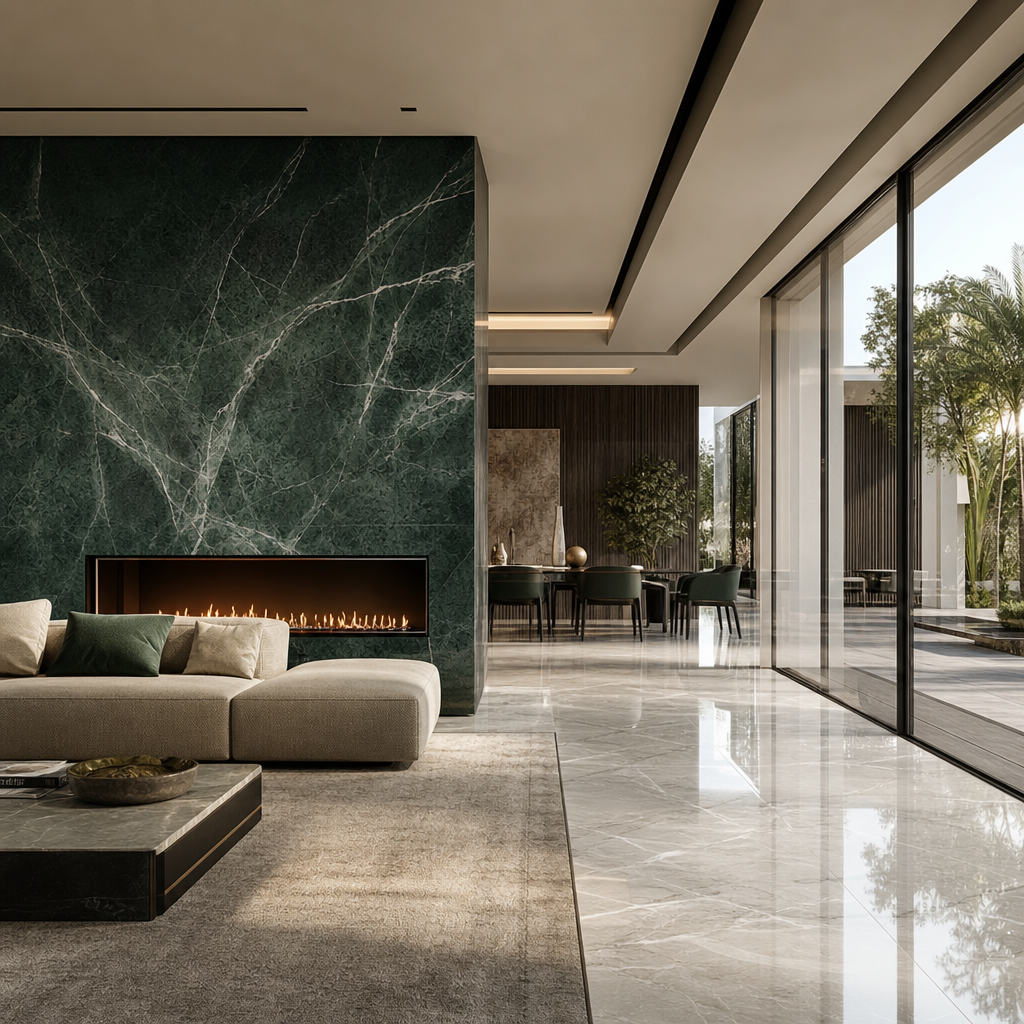
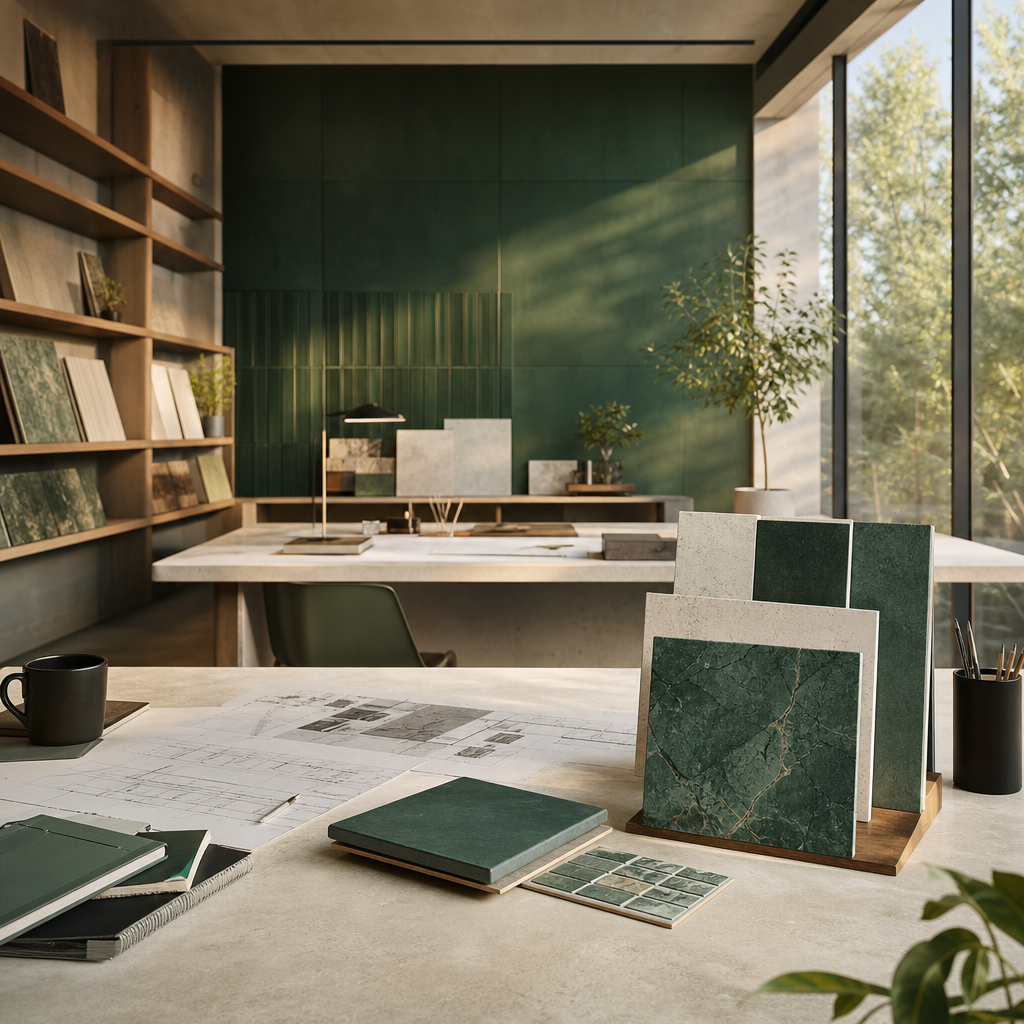
A luxury villa interior lives or dies by its surfaces. The best surfaces for luxury villa interiors in Iraq are the ones that hold a clean, high-end look through years of sun, dust, foot traffic and wet-area use without demanding constant repair or fussy upkeep. That is the lens behind this list. Rather than cataloguing every material on the market, we focus on the porcelain slabs, stone-look ranges and coordinated solutions we already supply and specify for villa projects across Iraq, and we tell you where each one fits, where it does not, and what to plan for before you commit.
Table of contents
How we selected these surfaces
Every item here is something we actually stock, display or guide for villa work, not a generic material pulled from the wider market. We judged each against four criteria so the shortlist stays honest and useful.
The first is proven performance in Iraqi conditions. Our porcelain and stone-look collections are specified for villas, towers and hospitals, where surfaces face heavy foot traffic, airborne dust, strong sun and wet areas without showing rapid wear. The second is fit with modern, minimalist and Scandinavian interiors: neutral, natural-stone looks and design-led ranges that let floors, walls and counters read as calm and intentional. The third is portfolio evidence, meaning surfaces that appear in our catalogue and project guidance, including Travertine Silver, marble-look slabs and graphic porcelain such as ABSTRA. The fourth is real-world support: we chose materials we can supply, price and help install, because a beautiful surface without reliable sourcing is a risk, not a feature.
Porcelain slabs: seamless luxury for floors, walls and counters
Porcelain slabs are large-format panels made from refined clays and minerals, pressed and fired above roughly 1,200 °C to form a vitrified, glass-like body. That process makes them extremely hard, non-porous and resistant to stains, chemicals and abrasion, which sets them apart from standard ceramic and from many natural stones in a demanding villa. Panels typically run 6–12 mm thick for walls and floors and 12–20 mm for countertops, balancing strength against a weight that can still be handled on site.
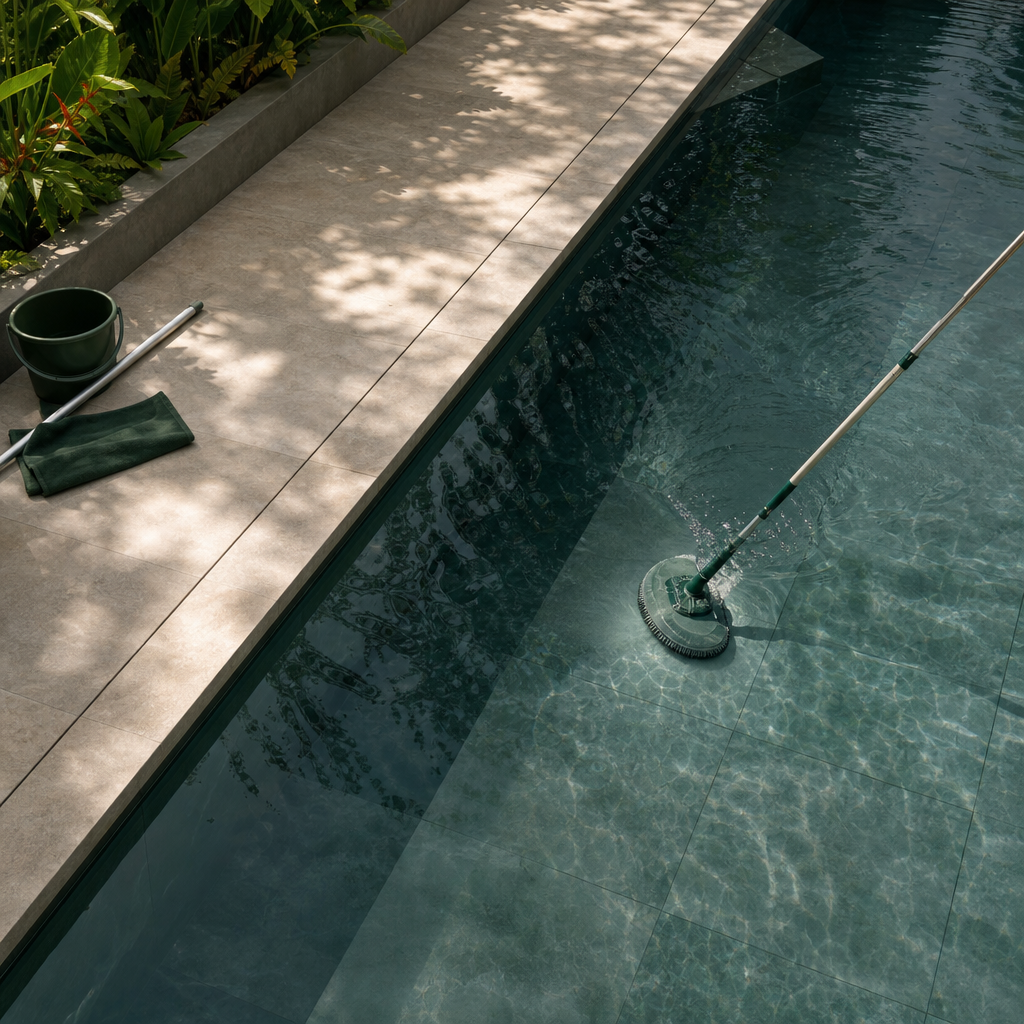
We treat porcelain slabs as a first-choice surface in several villa zones: family kitchens with heavy cooking and frequent spills, bathrooms and wet rooms that need waterproof, mould-resistant walls and vanity tops, and feature walls or lobbies where a clean, minimal look has to hold at scale. Outdoor-grade porcelain extends the same language outside, because it is UV-stable, heat-resistant and frost-resistant, which suits sun-exposed terraces, outdoor kitchens and facades through Iraq’s temperature swings. To understand how the material is made and where it performs best, our guide to what a porcelain slab is is a useful starting point.
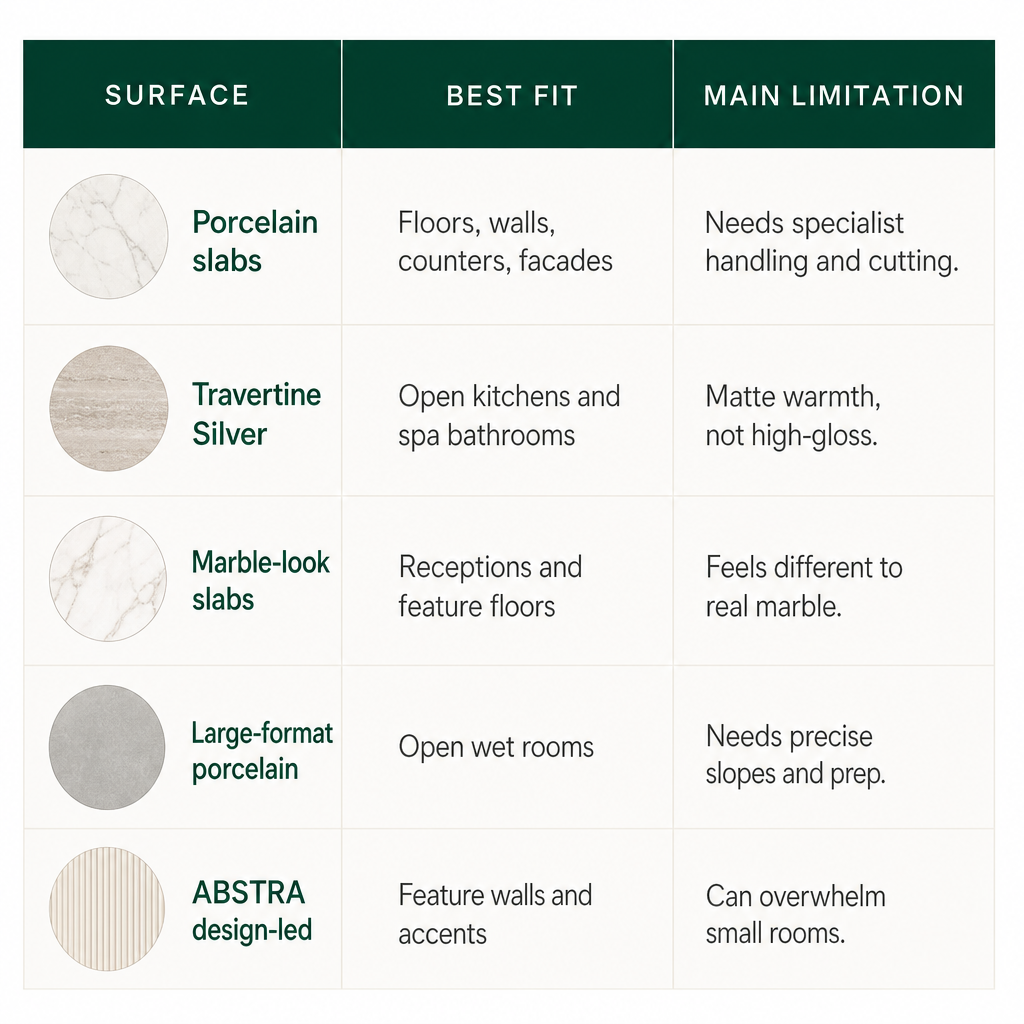
The trade-off is installation. Their size and density call for specialist handling, cutting and lifting equipment, so slabs are a professional job rather than a DIY one. Edge profiles, joint layout and slip-resistance ratings need to be fixed early, during sourcing, and tight stairwells or curved details sometimes work better when large slabs are combined with matching tiles to avoid awkward cuts. You can browse current panels and ranges in our surface and slab shop.
Travertine Silver: warm floors without raw-stone upkeep
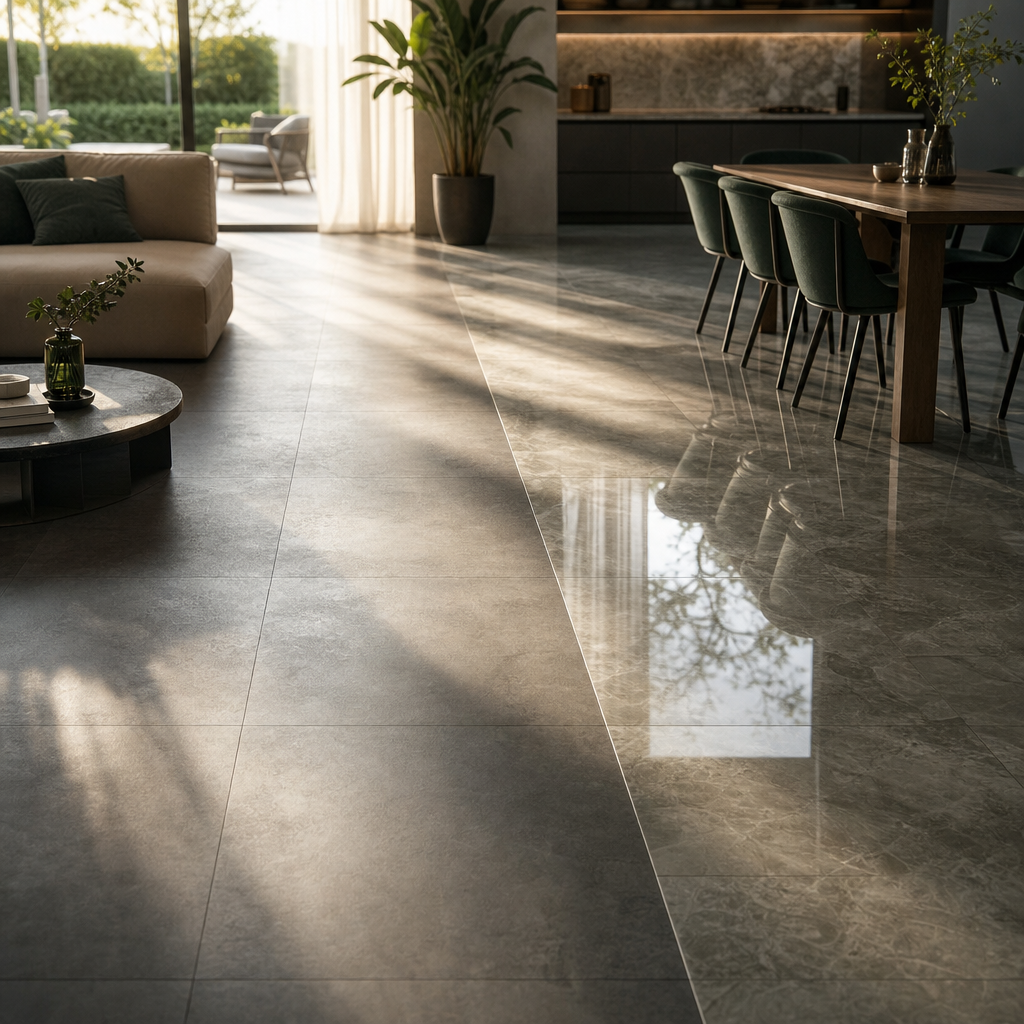
Travertine-look porcelain, and specifically our Travertine Silver range, brings Mediterranean warmth and soft stone movement in a tile that is far easier to live with than quarried travertine. It sits between rustic and modern, pairing naturally with oak cabinetry, soft greys and layered Scandinavian lighting. Sealed and maintained correctly, a Travertine Silver floor resists stains and moisture through busy cooking zones and spa-style bathrooms alike.
We recommend it most often for open-plan villa kitchens, where the floor has to tie living and dining areas together while still feeling cosy, and for master bathrooms, where the same tone across floors and walls creates a calm, spa-like shell. Wherever an owner wants the feel of natural stone but needs porcelain’s practicality in the local climate, this is a strong candidate.
There are limits worth naming. Even as porcelain, a travertine aesthetic rewards a planned sealing and cleaning routine to keep grout joints looking fresh. Its matte, relaxed character will not deliver the high-gloss, formal lobby look some owners associate with polished marble, so it belongs to relaxed luxury rather than mirror-bright reception halls. On budget, curated ranges like this sit above generic ceramic imports, so they should be specified with a clear area plan and a quote rather than folded into a vague tile allowance.
Marble-look porcelain slabs: statement luxury, manageable care
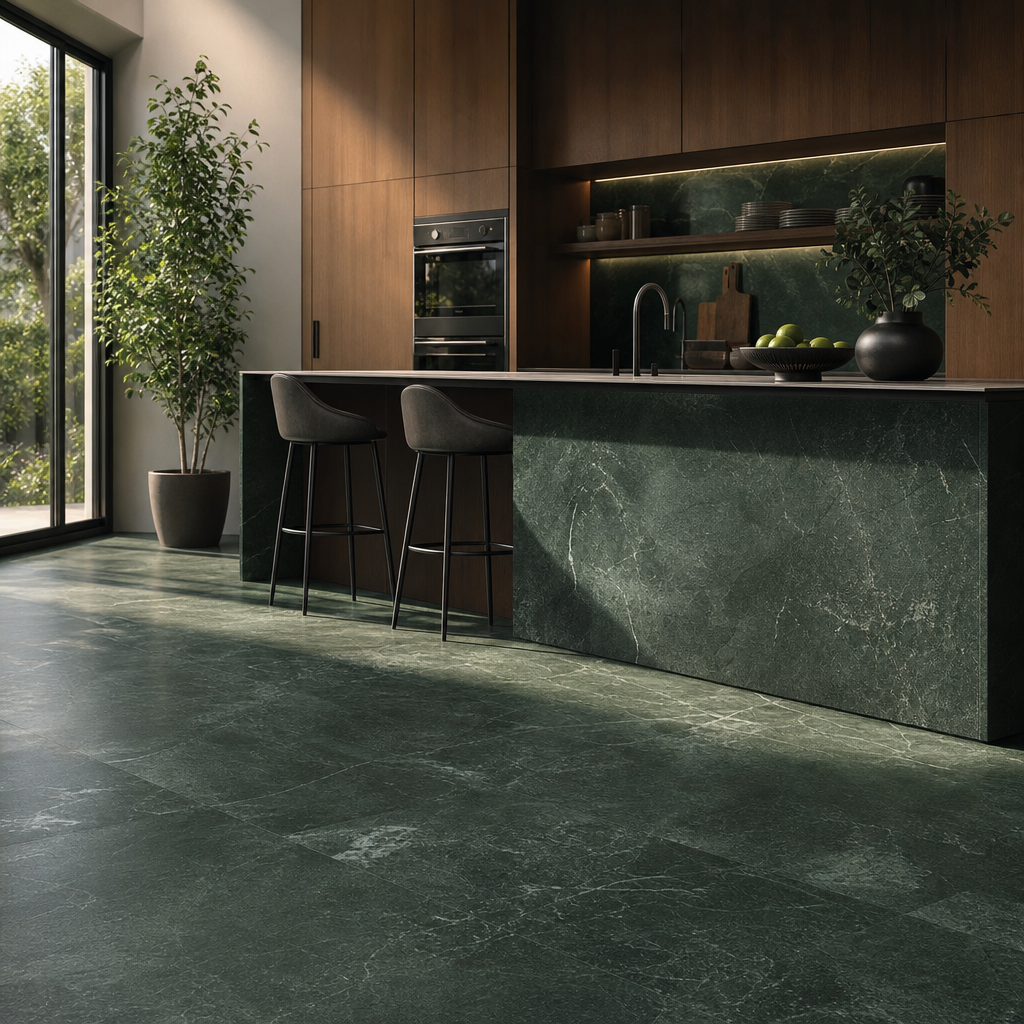
Marble-look porcelain slabs are engineered to capture the veining, depth and polished feel of natural marble on a dense, non-porous body that avoids marble’s sensitivity to acids and staining. Because the pattern prints across large formats, you can run sweeping statement floors, feature walls and long kitchen islands with consistent veining and fewer grout lines. Our overview of marble-look porcelain slabs in Iraq compares them with natural marble on maintenance, finishes and cost.
The fit is strongest in reception areas, double-height living rooms and formal dining spaces, where visual impact matters but maintenance has to stay realistic for a family home. On counters and shower walls, the same slabs give a luxury look while tolerating hot cookware, cleaning products and daily use better than many marbles when specified correctly. For villa developers, marble-look porcelain in lobbies and shared corridors projects prestige while cutting long-term cleaning and refurbishment compared with polished stone.
The honest caveats: it will feel different underfoot and to the touch than real marble, which matters to clients who insist on a fully authentic stone experience. Edge treatments and joint layouts need careful planning so veining is not interrupted across a large installation, and the cost band shifts with format, finish and technical grade, so budgets should come from a project-specific quote rather than a generic per-square-metre figure.
Large-format porcelain for open wet rooms and spa bathrooms
Large-format porcelain is what turns a bathroom from a standard tiled room into a continuous, spa-like shell. Big tiles or slabs across floors and walls cut the number of grout lines, simplify cleaning and lift the whole space toward a minimalist, hotel-style feel. Specified with the right slip-resistance and wear ratings, the surface stays both safe and durable under constant water.
The open wet room is the modern bathroom layout we are asked for most often, which makes large-format porcelain one of the most practical choices for contemporary villas. It works especially well in master suites, guest bathrooms and powder rooms where owners want seamlessness that is still easy to maintain. Combined with travertine- or marble-look designs, large formats give a villa one cohesive language from floor to ceiling. Our modern bathroom design ideas show how these layouts come together.
The demands are technical. Large formats need precise substrate preparation, accurate falls to the drain and experienced tilers; otherwise water pools and edges chip. In small bathrooms full of internal corners, oversized tiles can also produce heavy cutting and waste, which is why our designers often mix sizes from the same range to balance the joints. These surfaces sit at the premium end, so include them explicitly in the bathroom budget.
Design-led collections like ABSTRA: personality without clutter
Beyond pure stone looks, our portfolio includes design-led porcelain such as ABSTRA, which applies graphic and textural design to a high-performance body. In kitchens we favour it for its large formats, seamless minimalist look and low-maintenance surface under daily use. For architects and designers, these collections introduce subtle pattern, rhythm or texture without giving up porcelain’s technical advantages.
They earn their place on feature walls behind sofas, in dining areas, on kitchen backsplashes and up stairwells, especially in villas built on Scandinavian or minimalist principles that still want a focal point. On commercial-scale villas and mixed-use projects, they also help public reception areas read as distinct from private rooms while staying robust and easy to clean.
Strength is also the risk. Graphic porcelain can overwhelm a small room, so we use it in controlled doses, balanced against calmer stone-look floors and neutral furniture. Pattern direction and joint alignment have to be planned during installation to avoid visual noise, which makes sample viewing and layout planning at the showroom stage essential. As curated ranges, these tiles can carry a higher price than plain tiles, so room-by-room area calculations and quotes matter.
One showroom for surfaces, bathrooms and furnishings
We operate as a single showroom for tiles, slabs, bathroom solutions and interior furnishings, which lets us coordinate porcelain surfaces with furniture and lighting in one aesthetic language. For a luxury villa, that integration is the point: floors, walls, counters, wardrobes, sofas, dining tables, beds and lighting all have to work together rather than arrive as separate, mismatched purchases.
Whole-home renovations and new builds gain the most, because owners and developers can align surfaces with fixtures and furniture from the start instead of retro-fitting room by room. For architects and designers, an integrated source reduces the risk of clashing finishes and keeps a minimalist or Scandinavian concept consistent from living areas out to the terrace. You can see the collections and ranges we carry across our curated brands.
This approach works best when we are involved early, at design and specification rather than after structural work. It also helps to arrive with the basics: project type, villa location, zones and approximate areas in square metres, so we can quote accurately and propose coordinated collections. Because the showroom is built around premium, design-led options rather than discount imports, cost expectations should be set against long-term value and durability.
Matching surfaces to your villa zones
The fastest way to turn these options into a plan is to map the villa room by room and assign a surface to each zone:
- Living rooms and receptions: marble-look porcelain slabs or large-format stone-look tiles for main floors, with a design-led collection such as ABSTRA on one feature wall where you want focus.
- Open-plan kitchens and dining areas: Travertine Silver or similar travertine-look porcelain for warm, welcoming floors, and porcelain slabs or ABSTRA-type tiles on counters and backsplashes that must handle heat and spills.
- Master bathrooms and spa suites: Travertine Silver floors with large-format porcelain on walls for a continuous shell, plus marble-look slabs in shower niches or on vanity tops for extra richness.
- Guest bathrooms and powder rooms: large-format porcelain with good slip-resistance and easy-clean finishes, calmer overall, with an optional design-led accent wall for character.
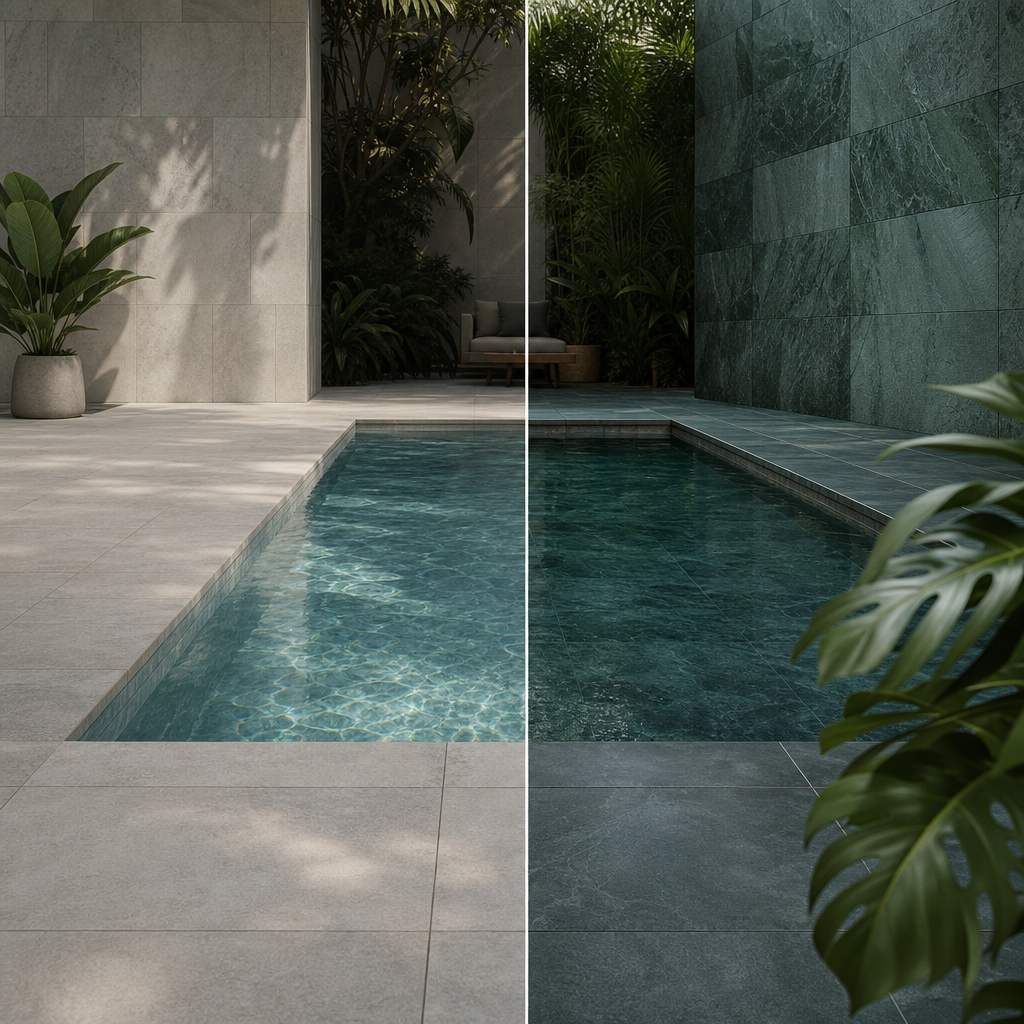
- Terraces, outdoor kitchens and facades: outdoor-grade porcelain slabs that are UV-stable, heat-resistant and frost-resistant, in stone-look or softly textured designs that echo the interior floors.
To refine the plan and tie it to a realistic budget, our guide on how to choose floor tiles for a villa and our walk-through on sourcing premium slabs for a villa project give the step-by-step inputs, zone priorities and sourcing sequence to work through before you order.
Frequently asked questions
What is the most practical luxury surface for villa floors in Iraq?
For most luxury villas, dense, non-porous porcelain slabs or large-format porcelain tiles are the most practical choice, combining high durability, stain resistance and easy cleaning with a modern look.
Are travertine-look tiles suitable for high-traffic villa kitchens?
Yes. We use Travertine Silver as a reference travertine-look porcelain that, sealed and maintained correctly, performs well in busy open-plan kitchens and connects the floor visually to the living areas.
Do marble-look porcelain slabs really replace natural marble in luxury projects?
They deliver a similar visual effect with far easier maintenance, greater resistance to staining and acids, and more predictable costs, which is why we recommend them for many high-end villa floors, counters and feature walls.
How should I budget for premium porcelain surfaces in a villa?
Standard porcelain tiles fall into a broad band, but curated, design-led collections and slabs must be quoted individually by project area, format, finish and technical grade. Our porcelain tiles price guide for Iraq explains what moves a quote, and supplying accurate room sizes lets us return precise figures.
Can one supplier coordinate all my villa surfaces and furnishings?
Yes. We work as an integrated showroom for tiles, slabs, bathroom solutions and interior furnishings, so homeowners, designers and developers can build a villa with consistent surfaces, furniture and lighting from one source.