No products in the cart.


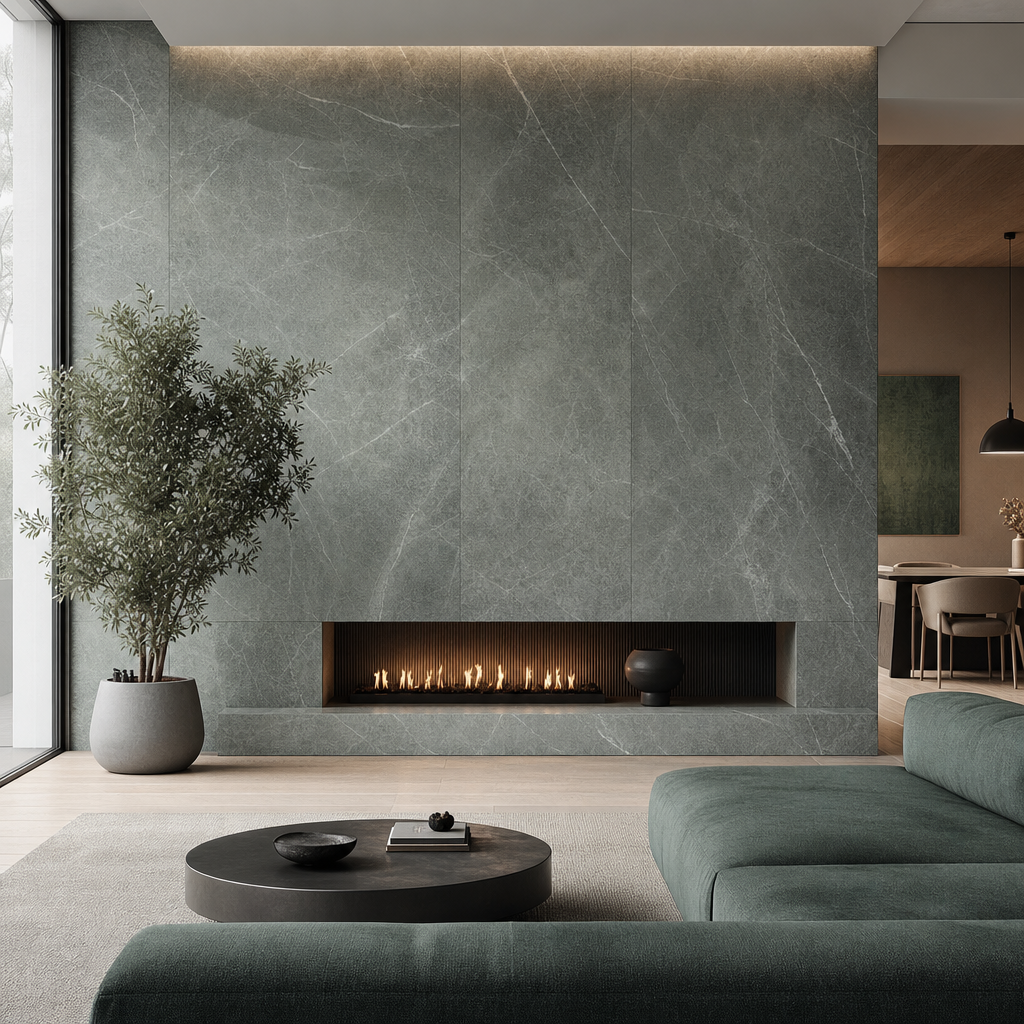
Large format tiles for walls give you a calmer, more continuous surface with far fewer grout lines than conventional tile, which is why they read so well in bathrooms, kitchens, feature walls, lobbies and villa receptions. The real decision, though, is rarely whether a big panel looks good. It is whether the wall, the tile format, the installation system and the access route all suit one another. Get that match right and the result is seamless; get it wrong and the same size that creates the drama also exposes every flaw.
At Agata Iraq we specify and supply porcelain and natural-stone-look surfaces for homes, towers, villas and hospitals, so this guide is written around the choices that actually change the outcome: where the format earns its place, when a large tile beats a slab, and the technical criteria that keep the finish flat, bonded and durable.
Table of contents
What “large format” actually means on a wall
Under the ANSI A137.1 definition, “large format” describes a tile with at least one edge measuring 15 inches or more. In day-to-day design work the term stretches to cover familiar rectified sizes such as 60 × 120 cm, larger panels, and full porcelain slabs that can reach roughly 3.2 × 1.6 m or more, in thicknesses commonly around 6–12 mm depending on the collection.
That range matters because two products can look almost identical on a showroom wall and still demand completely different handling. A porcelain slab is an extra-large vitrified panel pressed and fired from refined clays, feldspar, silica and mineral oxides, which makes it suitable for shower walls, full-height backsplashes and feature walls where fewer joints are the goal. If you want the full technical picture before choosing, our simple guide to porcelain slabs explains how the panels are made and where they belong.
The one habit that prevents most problems is simple: confirm the exact size, thickness, weight and installation requirements from the product’s technical sheet rather than from the size you see on display. Every criterion below depends on those numbers.
Why the format works on walls, and where it doesn’t
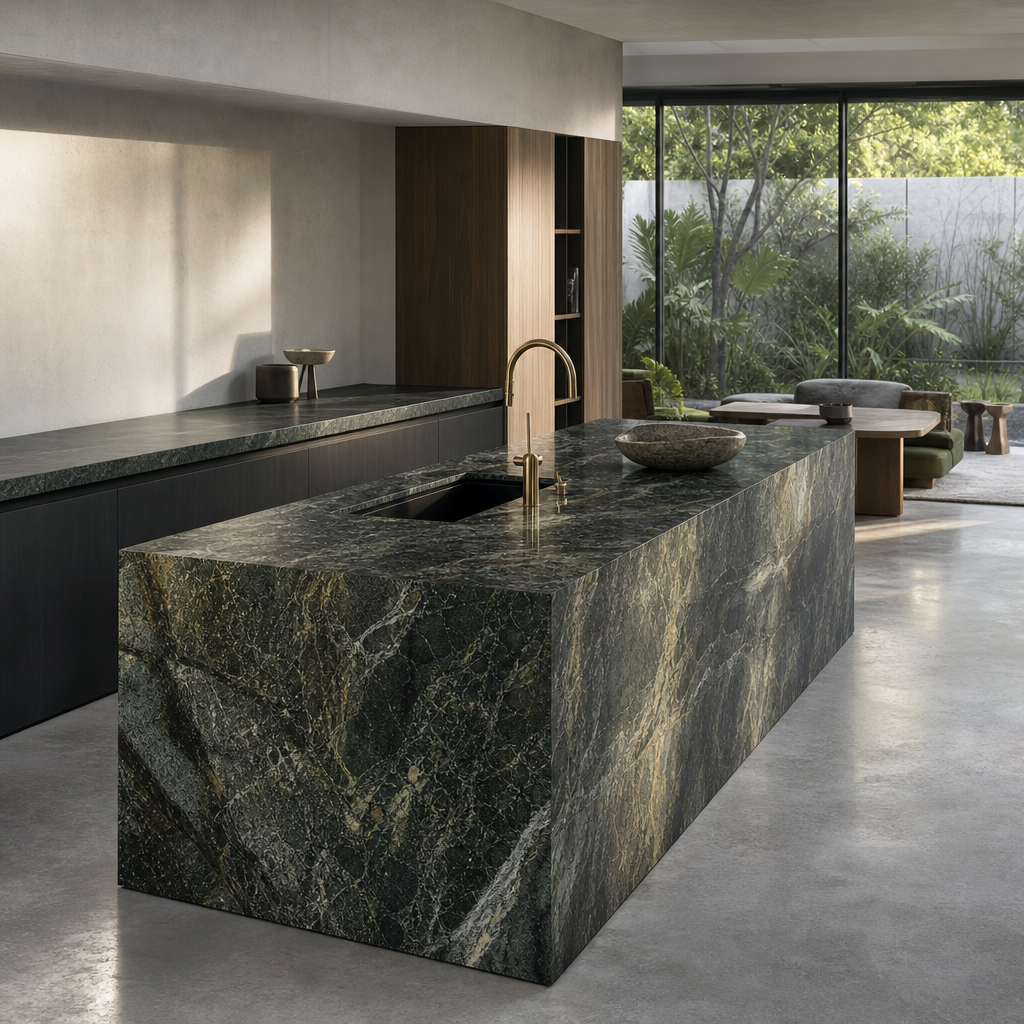
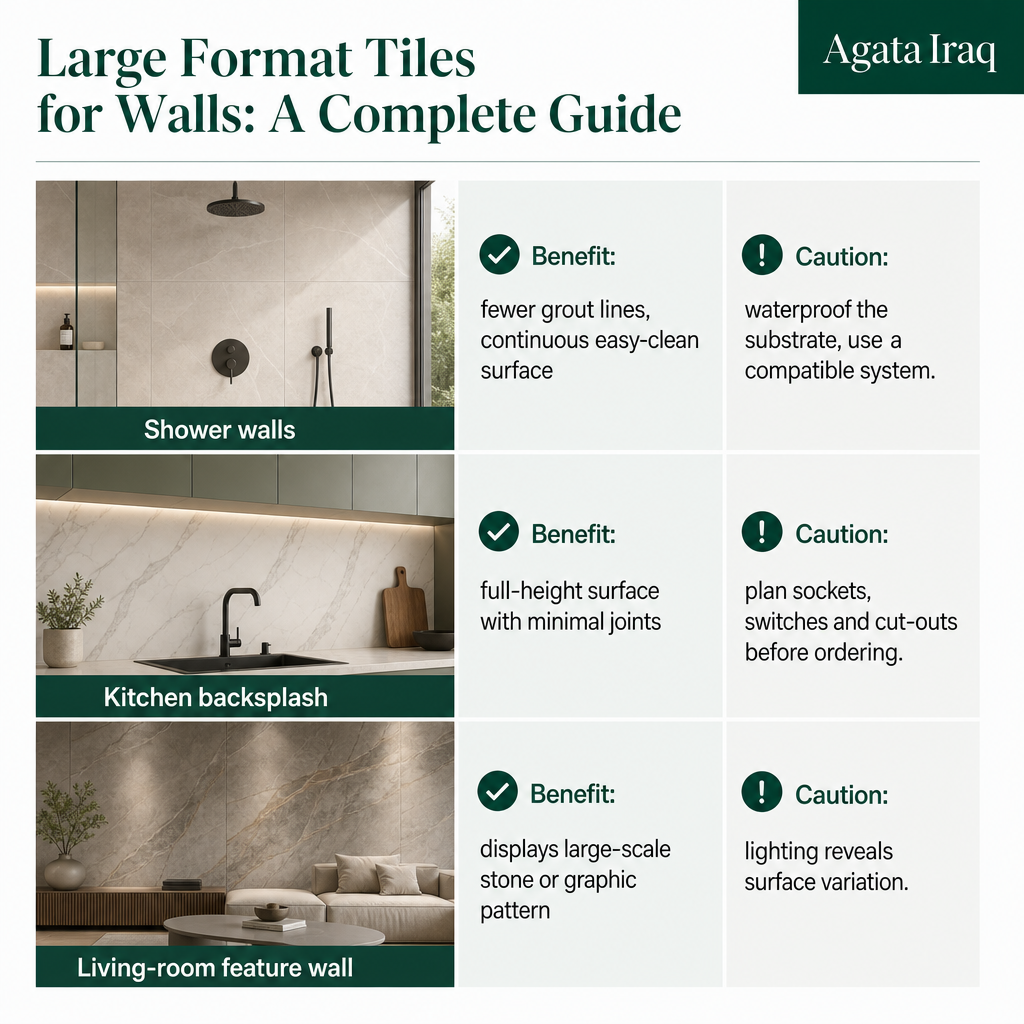
The headline benefit is visual continuity. Fewer, larger pieces mean fewer grout joints interrupting a stone, concrete or marble-look pattern, which also means fewer lines where dust, soap residue and discolouration can gather. On a full-height shower wall, a kitchen backsplash, a fireplace surround or a reception wall, that continuity is the whole point.
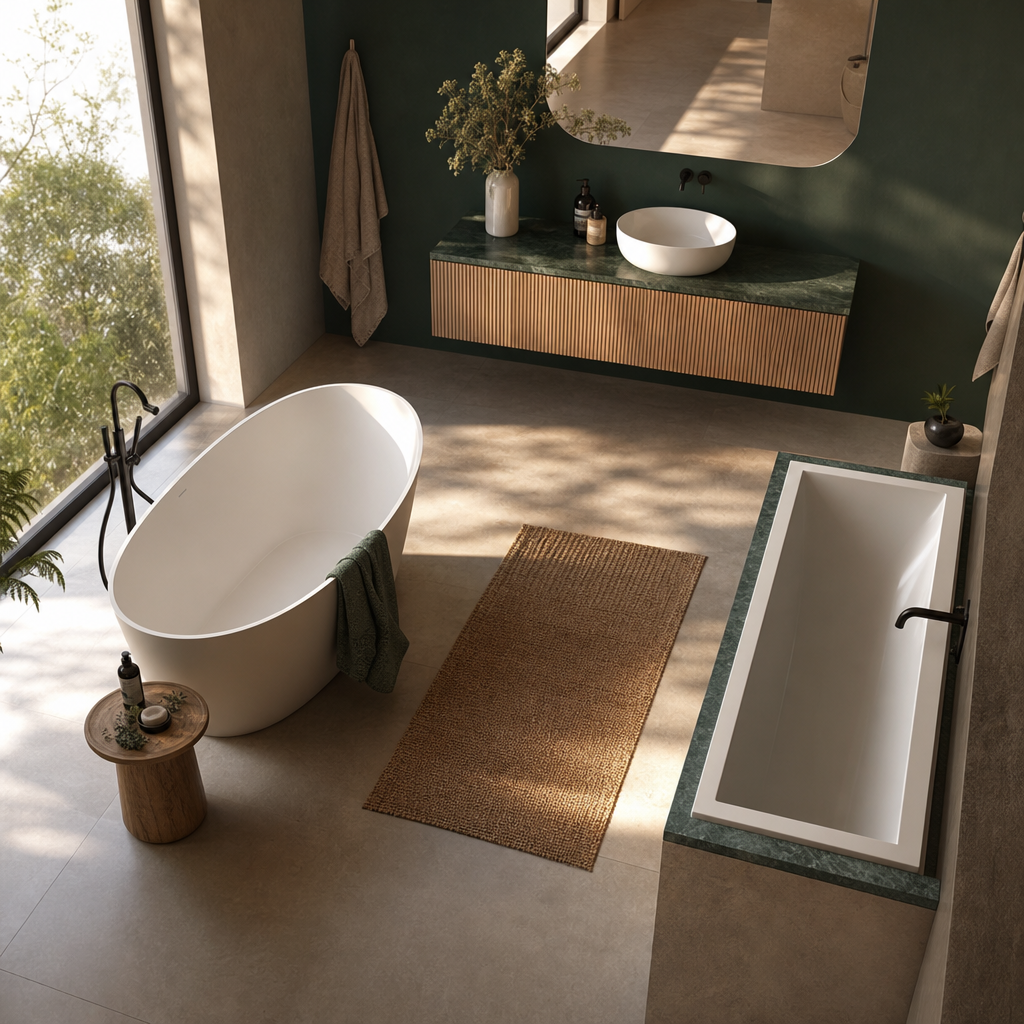
There is a spatial effect too. In a compact bathroom or narrow room, fewer interruptions can make the space read as more open, and light-coloured stone-look porcelain reinforces it when the same surface carries across several walls. This is not automatic. Poor alignment, uneven joints or an unsuitable pattern make a large wall look busier, not calmer, so the effect depends entirely on flatness and setting-out.
Large panels also let a graphic pattern breathe. A single sweep of veining or a concrete texture across a broad surface is far more convincing than the same small motif repeated across dozens of tiles. For a minimalist wall, a Scandinavian-neutral room, a dramatic marble-look feature or a travertine-inspired bathroom, scale is the design. Our ABSTRA porcelain collection is a useful starting point when a project wants a graphic or textural surface, with product-specific dimensions and finishes confirmed before specification.
Finally, porcelain itself performs. It is a dense, vitrified material with water absorption generally below 0.5%, though the exact figure should be checked per product. That low absorption suits walls exposed to steam, splashes, cooking residue and frequent cleaning. It does not, however, replace waterproofing: a porcelain tile is water-resistant, but the wall assembly behind it still needs correct detailing in any wet area.
Large format tile or porcelain slab?
The two terms are related but should not be treated as interchangeable, because the choice between them affects transport, cutting, installation skill and future repairs.
A large format tile is usually a bigger version of a conventional tile, available in formats such as 60 × 120 cm. It still needs a flat substrate and experienced setting, but it is generally easier to carry, cut and replace than a full panel. That makes it the pragmatic choice where access is restricted, the wall has many openings, or you want simple future replacement.
A porcelain slab is a much larger panel designed to cover a wall in one or a few pieces. It delivers the fewest joints and the most seamless result, but it normally demands more careful transport, specialist lifting equipment, precise cutting, careful planning around sockets and plumbing, and a more experienced installation team. Reach for a slab when visual continuity is the priority and the site can genuinely accommodate the panel safely.
The decision criteria that decide the outcome
Wall flatness comes first. Large tiles do not conform to an uneven wall. High spots prevent proper adhesive contact; hollows leave unsupported voids behind the panel, and the result can be lippage, cracking or debonding. The substrate must be inspected and corrected before tiling, not patched by adhesive. Published large-format guidance commonly requires tighter tolerances than ordinary tile work — one installation guide specifies no more than 1/8 inch variation over 10 feet and no more than 1/16 inch over 24 inches for tiles 15 inches or larger. Use the tolerance required by your selected tile and adhesive manufacturer.
Weight and wall capacity decide what is even possible. A tall or thick porcelain panel can be heavy, so confirm panel weight per square metre, total weight per panel, wall construction, plaster or render condition, backer-board suitability, the fixing system, and whether mechanical support is required. A sound-looking painted wall is not automatically a suitable substrate for a slab.
Adhesive coverage keeps the panel supported. Voids behind a large tile create weak points, especially near corners and edges. The adhesive system should be chosen for porcelain’s low absorption, the panel’s size and weight, interior or exterior exposure, wet or dry use, substrate type and movement conditions. Let the tile and adhesive technical sheets set the mortar classification, trowel method and coverage — never select adhesive by colour or a general-purpose label.
Access can stop a perfect tile at the front door. Before ordering a slab, check the entire route: vehicle access, site entrance, staircases and lifts, door widths, corridor turns, storage, working height, lifting equipment and edge protection. A panel can fit the wall and still be impossible to move safely through the building — a constant issue in towers, upper-floor villas, hospitals and occupied renovations.
Layout and cut-outs need to be set out early. Mark sockets, switches, mixer controls, shower niches, floor outlets, plumbing penetrations, wall-hung toilets, mirrors, cabinets, ventilation openings and door reveals before cutting. A layout that looks balanced on a drawing can produce narrow strips or awkward cut-outs on site, so dry planning protects both waste and the visual rhythm of the wall.
Pattern direction is a material decision, not an afterthought. Stone-look surfaces may have directional veining or repeated graphics. Decide early whether you need continuous veining, book-matching, symmetrical panels, vein alignment at corners or a deliberate change of direction, because matching increases both material and installation time. Inspect the actual slabs together before cutting.
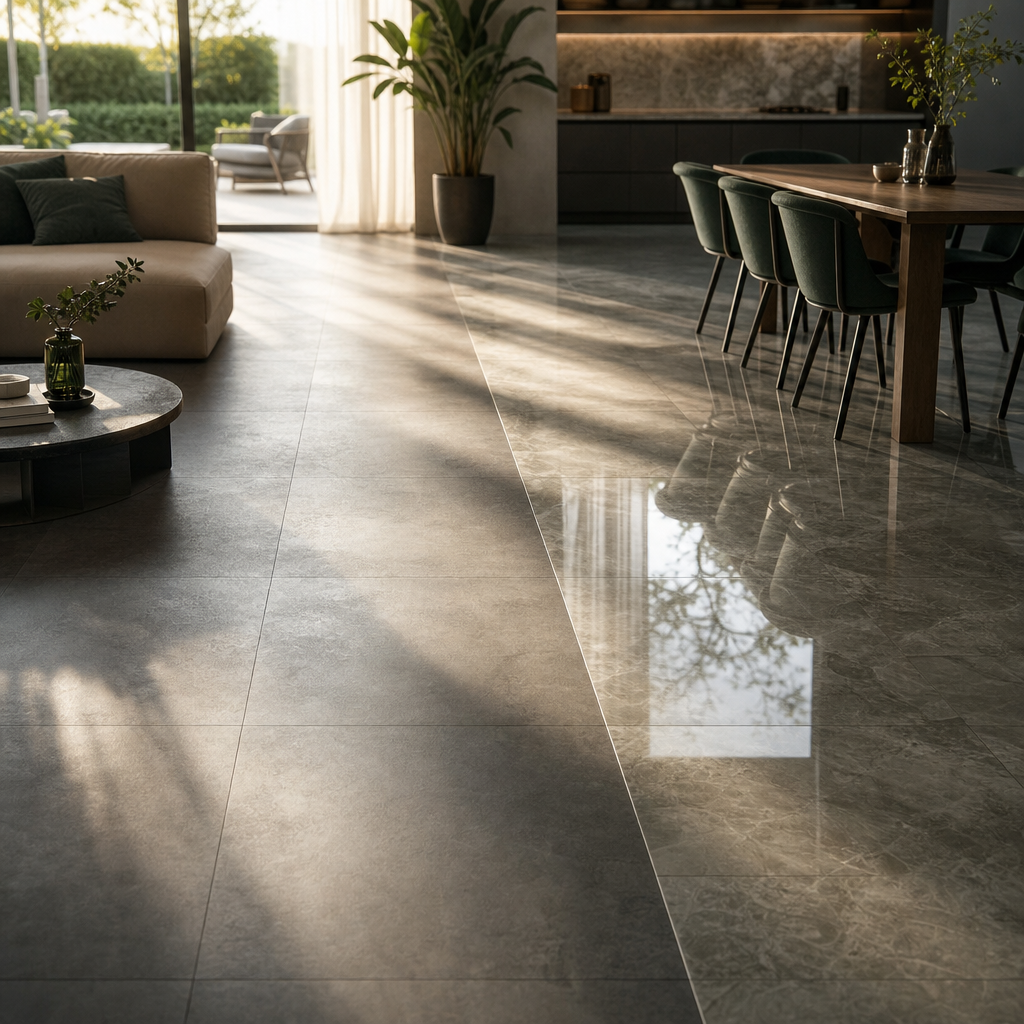
Finish interacts with lighting. Glossy large tiles bounce light across a wide surface, which brightens a room but also magnifies substrate waves, uneven coverage, lippage and strong spotlights. Matte or softly textured finishes are usually more forgiving. If you are weighing the two, our guide to matte versus glossy tiles covers the wider trade-off; for walls specifically, review the lighting at the design stage.
Movement joints and waterproofing in wet areas
Large tiles are rigid, but buildings are not. Thermal change, shrinkage, vibration and structural movement all put stress into the assembly, and movement joints exist to absorb that movement instead of forcing it into the tile or grout. They are not decorative. Large-format guidance recommends carrying structural and control joints through the tile installation rather than bridging them with tile, and manufacturer guidance identifies perimeter and intermediate movement provisions as necessary to reduce detachment caused by thermal expansion and contraction.
Depending on the project, flexible joints may be needed at room perimeters, internal and external corners, changes of plane, around columns and fixed elements, over structural or substrate joints, between different substrate materials, at planned intervals across larger areas, and wherever the wall receives direct sun or significant temperature swing. Spacing and width follow the applicable standard, the substrate design and the tile-system manufacturer’s instructions. One rule is absolute: never fill a required movement joint with rigid grout.
Waterproofing follows the same logic in showers and bathrooms. Large format porcelain is suitable for shower walls, but it is only one layer of the system. A durable wet wall depends on a stable substrate, correct waterproofing, properly treated corners and penetrations, compatible primer where required, the right adhesive, correct movement joints, and sealed transitions around fixtures and niches. Water-resistant tile cannot correct defective waterproofing behind it — if water reaches the substrate through a failed joint or corner, the fault is in the assembly, not the porcelain. For wet-area planning alongside the tile choice, our walk-in shower guide covers layouts and detailing.
Common risks and how we control them
Most large-format failures trace back to a handful of causes, and each has a clear control. The table below pairs the risk with its practical fix so you can brief an installer or check a method statement.
| Risk | Likely cause | Control measure |
|---|---|---|
| Cracked panels | Uneven substrate, unsupported voids, building movement, stress at cut-outs | Flatten the wall, use the specified adhesive, carry movement joints through, protect edges |
| Chipped edges | Poor cutting tools, transport impact, forced joints, exposed corners | Use specialist cutting, protect edges in handling, plan cut-outs, add trims where needed |
| Lippage and misaligned joints | Wall flatness, inconsistent coverage, inaccurate setting-out, tile warpage | Check the wall before ordering, set datum lines, dry-plan, use a levelling system |
| Difficult future repairs | A damaged panel can mean removing sanitaryware or cabinetry | Keep spare material from the same batch; record product, shade, calibre and lot |
One more risk is quieter: overstated performance. Porcelain is durable and low-absorption, but suitability for exterior fçades, extreme heat, fireplace use, freezing, heavy commercial traffic or chemical exposure depends on the specific product. Confirm the technical classification and intended use before you specify, rather than assuming every porcelain panel does everything.
Specifying large format tiles for a project in Iraq
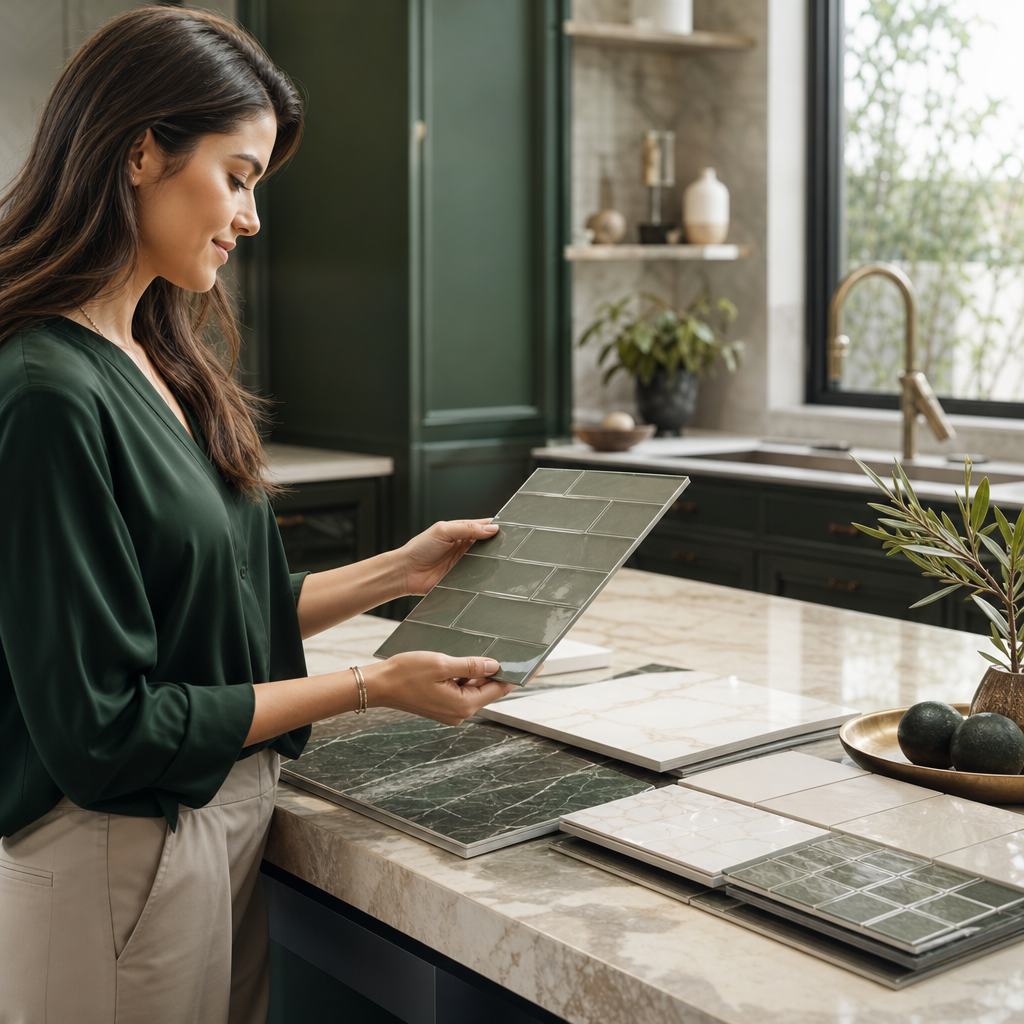
A professional tile schedule records far more than colour and pattern. For a villa, tower or hospital it should capture the product and collection name, material, exact dimensions, thickness, finish, shade and calibre, the intended wall location, interior or exterior use, wet or dry area, substrate type, adhesive specification, waterproofing system, joint width, movement-joint locations, edge and corner treatment, pattern direction, required quantity with a waste allowance, handling and lifting requirements, installer responsibility, and inspection and approval points. Approval samples should show not only the tile but the proposed grout, trim, corner, junction and lighting conditions.
Local conditions raise the stakes. Dust, active construction sites, intense sunlight, sharp air-conditioning cycles and difficult delivery routes all affect the installation, so panels should be stored as the manufacturer directs, protected from impact, and fixed only after the wall is ready. The format suits modern apartment bathrooms, villa entrance walls, full-height kitchen backsplashes, shower rooms, feature walls, receptions and commercial interiors — provided the team plans for access and substrate preparation.
At Agata Iraq we supply tiles, slabs, bathroom solutions and interior furnishings through a design-led showroom, including porcelain and natural-stone-look surfaces such as Travertine Silver, listed under tiles and the Qua brand. If you are comparing material options first, our explainer on porcelain versus ceramic tiles sets out how these surfaces behave on walls in minimalist, bathroom and project interiors.
For a straightforward renovation, large porcelain tiles often strike the best balance between visual scale and manageability. For a full-height feature wall, shower enclosure or reception surface, a slab can deliver a more seamless result — but only with proper technical planning and specialist installation. The right call comes from the wall, the access route and the installer, not from the sample alone.
Frequently asked questions
Are large format tiles better for bathroom walls?
They can be, when you want a continuous appearance with fewer grout lines and the wall is flat, waterproofed and able to carry the tile’s weight. They are not automatically better where access is difficult or the substrate is uneven.
Do large format wall tiles need a special adhesive?
Usually. The adhesive should be chosen for porcelain, the tile’s size and weight, the substrate and the exposure conditions, following the tile and adhesive manufacturers’ technical instructions rather than a general-purpose product.
Can large format tiles be used in a shower?
Yes. Porcelain large-format tiles suit shower walls when the substrate is correctly waterproofed and the installation system is compatible. The tile itself does not replace the waterproofing layer.
Do large format tiles still need grout?
Yes. They reduce the number of joints but do not eliminate them, and joint width follows the product guidance. At specified movement joints and changes of plane, use a flexible sealant rather than rigid grout.
What should I ask a tile supplier before ordering?
Ask for the exact product name, dimensions, thickness, technical sheet, available stock, shade and calibre, recommended adhesive, movement-joint requirements, handling method and estimated wastage — and whether the showroom can coordinate the tile with fixtures, lighting and cabinetry.